DATAMATH CALCULATOR MUSEUM
|
DATAMATH CALCULATOR MUSEUM |
Texas Instruments TI-30 eco RS
| Date of introduction: | 1999 | Display technology: | LCD |
| New price: | Display size: | 10 + 2 | |
| Size: | 5.9" x 3.0" x 0.50" | ||
| Weight: | 2.9 ounces | Serial No: | |
| Batteries: | n.a. | Date of manufacture: | mth 01 year 2001 |
| AC-Adapter: | Origin of manufacture: | China | |
| Precision: | 12 | Integrated circuits: | |
| Memories: | 3 | ||
| Program steps: | Courtesy of: | Joerg Woerner |
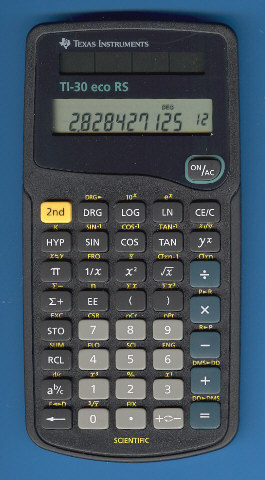

 This
calculator is identical to the TI-30Xa Solar
introduced in the year 1996. The main difference is the marketing concept.
This
calculator is identical to the TI-30Xa Solar
introduced in the year 1996. The main difference is the marketing concept.
The housing is made of recycled plastic and together with the
solar cells instead of batteries this allowed Texas Instruments Germany to use
the "Umweltzeichen" sign.
 Consumers in Germany call it the
"Blue Angel". Its official name is "Umweltzeichen"
(Environmental Label or the "Eco-Mark"). What they are referring to is a special logo, which has for two decades now been a symbol for products with positive environmental features on the German market. Well over
3,800 products now bear the mark. This success is proof of the increased environmental awareness both of producers and of consumers. Because the Environmental label is an entirely voluntary labeling of a product’s environmentally friendly
features.
Consumers in Germany call it the
"Blue Angel". Its official name is "Umweltzeichen"
(Environmental Label or the "Eco-Mark"). What they are referring to is a special logo, which has for two decades now been a symbol for products with positive environmental features on the German market. Well over
3,800 products now bear the mark. This success is proof of the increased environmental awareness both of producers and of consumers. Because the Environmental label is an entirely voluntary labeling of a product’s environmentally friendly
features.
Don't miss the TI-36 eco RS calculator introduced in the same year.
 Read
more about the Logarithm Bug and its
side effect on the related yx function present in this calculator.
Read
more about the Logarithm Bug and its
side effect on the related yx function present in this calculator.
Texas Instruments introduced in April 2004 a slightly redesigned TI-30 ECO RS for the German market.
 |
 |
| The Blue
Angle Powered by Solar-cells |
The Blue
Angle Without Battery |
"The important thing about the Blue Angel is the bottom line result: a positive balance for the environment."
In
the tension between ecology and economy, the line of argument which leads to a
solution for all parties – business, consumers, commercial purchasers and not
least the environment – is both simple and compelling; ecologically optimized
products provide sustainable relief to the strain on the environment.
Environmental awareness in the behavior of consumers is the decisive factor in
the provision of ecologically beneficial products and services by industry and
retailers. However, in order to evaluate the environmental properties of
products and services, consumers need reliable information and clear labeling.
This is where the Blue Angel comes in: it guarantees an ecologically better
alternative product according to defined criteria – and it enables consumers
to demonstrate for their "right to the environment" in the things they
buy.
The Blue Angel is not based on directives and prohibitions; it is based on
information and motivation – and the conviction and commitment of producers
and consumers alike.
So what are the results of the Blue Angel today? About 710 companies and 3,800
products use this environmental label. And about half of the consumers in West
Germany and almost a third in East Germany take it into account when they go
shopping. This makes the Blue Angel a signpost for the environmental awareness
of consumers.
The Blue Angel rewards businesses which show commitment, creativity and
innovation for the protection of the environment. It highlights products and
services which are optimized in their impact on the environment. The Blue Angel
offers companies added credibility to advertise their ecologically beneficial
products in the market. And according to the users of the label, the Blue Angel
has stimulated competition for ecological innovation and the ecological quality
of the products and services offered. It is agreed that the classics of the
Environmental Label – such as returnable bottles and recycled paper – have
long become successfully established in the market. Any you will not find a DIY
store which does not sell low-pollutant paints and varnishes bearing the
Environmental Label. The Blue Angel was and still is the trendsetter for
product-related environment protection.
These points alone are sufficient reason for me to appreciate the Blue Angel as
a valuable and indispensable instrument in our environmental policies. It is a
dynamic environmental label which takes an abstract principle and fills it with
life and meaning.
I wish the Blue Angel every success as it continues along this path.
Jürgen Trittin
Federal Minister of the Environment, Nature Protection and Nuclear Safety
Searching
the website www.blauer-engel.de
results in a total of only 8 electronic pocket calculators awarded with the
environmental label Solar-Powered
Products and Mechanical Watches/Clocks RAL-UZ 47:
| Casio Europe GmbH | SL-450L |
| Fx-82 SOLAR | |
| Texas Instruments Deutschland GmbH | TI-106 |
| TI-1726 | |
| TI-30 eco RS | |
| TI-30Xa Solar | |
| TI-36 eco RS | |
| Solar Little Professor |
It
is quite interesting that not only the two calculators TI-30 eco RS and TI-36
eco RS decorated with the Blue Angel comply with the requirements of RAL-UZ 47
but even the twin TI-30Xa Solar.
The
above mentioned RAL-UZ 47 covers a lot of solar powered
products, please find below a version stripped down to cover only pocket
calculators. Reading these criteria carefully points it out that the Blue Angel
is just a marketing concept, not a development target. There are only four
relevant requirements:
| • Solar
cells with an efficiency to supply the calculator at 50 lux • No battery, not even a holder for it • No parts with cadmium • No capacitors with PCB (Polychlorinated Biphenyls) |
These
four requirements could easily compressed to only the first one because:
|
• A
pocket calculator with solar cells running at 50 lux ambient light doesn’t
need batteries because you can‘ read the display in the dark. Disadvantage of such a calculator is its volatile memory. • Cadmium is widely used, 70 % of its use is in rechargeable nickel-cadmium batteries and 13% as pigments to produce intense colorings such as yellow, orange and red in plastics, glasses and ceramics. Usually calculators are grey to black, only the Little Professor looks different. • "Capacitors with PCB" are usually power-capacitors filled with PCB, they were discontinued already in 1976. |


1 Preliminary Remarks 1.1
In cooperation with the Federal Minister for the Environment, Nature
Conservation and Nuclear Safety, the Federal Environmental Agency and
considering the results of the expert hearings conducted by RAL, the
Environmental Label Jury has set up these Basic Criteria for the Award
of the Environmental Label. 1.2
Mercury and its compounds are among the most dangerous environmental
pollutants. About half the mercury in domestic wastes comes from
batteries. Batteries and especially accumulators also contain cadmium,
another non-degradable pollutant.

RAL, reg. assoc., has been entrusted with the award of the Environmental
Label.
Upon application to RAL and on the basis of a Contract on the Use of the
Environmental Label to be concluded with RAL the permission to use the
Environmental Label may be granted for all products, provided that they
comply with the requirements as specified hereinafter.
Alternative products driven by solar energy are useful substitutes for
environmentally noxious batteries and thus help to reduce the
heavy-metal impact on air, soil and water by mercury and cadmium.
2
Scope
These Basic Criteria apply to solar-powered pocket calculators.
3
Requirements 3.1
Energy supply by battery, accumulator or power unit shall not be
admissable. Also, constructional design shall preclude the possibility
of using these sources of energy. 3.2
Solar cells used in solar-powered pocket calculators must guarantee
full functioning at a minimum illuminance of 50 lux. 3.3
No cadminated parts must be used. 3.4
Built-in capacitors must not contain any organic halogenated
compounds (e.g. PCB). 3.5
not
applicable
The Environmental Label shown above may be used for the marking of
products under paragraph 2, provided that they comply with the following
requirements:
4
Compliance Verifications 4.1
for solar-powered devices: pursuant to paras. 3.1, 3.3 and 3.4. 4.2
not applicable 4.3
not applicable 4.4
Such declaration is to be presented together with a Technical Data
Sheet and/or Instructions for Use.
Applicant shall declare compliance with the requirements.
The declaration is to be supplemented by data required according to
para.3.2 (illuminance).
5
Applicants and Parties Involved 5.1
Applications may be filed by distributors of products pursuant to
para. 2. 5.2
Apart from the parties involved in the award procedure:
(RAL, Umweltbundesamt [Federal Environmental Agency] and the Federal
State where applicant's company is located) no further parties shall be
involved.
6
Use of the Environmental Label 6.1
The terms governing applicant's use of the Environmental Label are
stipulated by a Contract on the Use of the Environmental Label to be
concluded with RAL. 6.2
Within the scope of such contract applicant undertakes to comply
with the requirements under para. 3 as long as he makes use of the
Environmental Label. 6.3
Contracts on the Use of the Environmental Label are concluded for
the marking of products according to para. 2.
These contracts shall run until December 31, 2004. They shall be
extended by periods of one year each, unless the contract is terminated
in writing by March 31, 2004 or by March 31 of the respective year of
extension.
If you have additions to the above article please email: joerg@datamath.org.
© Joerg Woerner, December 5, 2001. No reprints without written permission.