DATAMATH CALCULATOR MUSEUM
|
DATAMATH CALCULATOR MUSEUM |
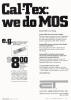
Cal-Tex Semiconductor, Inc. was founded in 1971 in Richardson, TX by former Texas Instruments and Nortec employees as a designer and manufacturer of Custom PMOS (p-channel Metal–oxide Semiconductor) chips with a strong focus on electronic calculators. If this plot sounds familiar: When Texas Instruments asked in 1969 many of their engineers to move from Dallas, TX to its new facility in Houston, TX, a group of them decided to stay in Dallas and founded Mostek. While Mostek's first wafers were made in Sprague Electric's site in Worcester, MA before they started their own manufacturing site in Dallas, Cal-Tex was taking a different approach. Within the first few months they moved the company to Santa Clara, CA and we are not sure if the Cal in Cal-Tex is for Calculators or California.
Santa Clara, also known as the birthplace of Intel's famous 4004 microprocessor - and the center of Silicon Valley - offered a perfect environment for startup companies in the field of microelectronics: First, a huge talent pool of design engineers, process engineers and test engineers; and second a prefect infrastructure from rubylith conversion through wafer manufacturing and testing, to chip packaging. And important for Cal-Tex, California was in the early 1970s the gateway to the leading calculator manufacturers in Japan.
When Mostek introduced the MK6010 in November 1970 - the World's first single-chip calculator circuit - it was sold exclusively to Nippon Calculating Machine Corp. of Japan for use in their Busicom Model 120-DM desktop calculator, also known as the Busicom Junior.
Cal-Tex quickly recognized the gap in the market and moved to address it by developing the CT5001 as a drop-in replacement for Mostek's MK6010. The company formally introduced the CT5001 in November 1971, with first silicon becoming available by January 1972.
Eiko Business Machines, which acquired a stake in Cal-Tex in early 1972, became the largest customer for the CT5001. The chip was used not only in their Unitrex-branded Model 1200 desktop calculator but also supplied to a range of OEM customers including ABM, Blauring, Elite, MBO, and Privileg. Notably, Eiko Business Machines later went on to establish Frontier Inc. in Costa Mesa, CA to develop their own line of calculator chips.
Cal-Tex introduced soon with the CT5002 a single-supply version of the CT5001 optimized for portable, battery-powered calculators with LED displays. When Busicom started early in 1972 to struggle financially and decided to forfeit its right of exclusivity, Mostek rebranded the MK6010 to MK5011 and its low power sibling MK6010L to MK5012. Cal-Tex followed with the CT5012, their low-power version of the CT5001.
 The CT5001's full socket compatibility with the MK6010 (and later the MK5011) initially seemed advantageous, but it soon became a liability. While Mostek handled everything from
chip design and layout to wafer fabrication, packaging, and testing, Cal-Tex depended on third parties for manufacturing and testing
- an unfavorable position during a price war. As a result, companies such as Eiko quickly abandoned the CT5001, replacing it in the bestselling Unitrex 1200 (Version 2) with Mostek's MK5011.
Triggered by the early successes of the CT5001 and understanding the disadvantages of being
"fab-less", Cal-Tex started in 1972 to invest into their own Semiconductor manufacturing plant in Houston, TX.
Cal-Tex announced for April 1972 with the CT5003/CT5004 Chipset a solution for printing desktop calculators with 8 to 16 digits and Memory function to compete with Mostek's R1200 Chipset, but never introduced the
chips.
The CT5001's full socket compatibility with the MK6010 (and later the MK5011) initially seemed advantageous, but it soon became a liability. While Mostek handled everything from
chip design and layout to wafer fabrication, packaging, and testing, Cal-Tex depended on third parties for manufacturing and testing
- an unfavorable position during a price war. As a result, companies such as Eiko quickly abandoned the CT5001, replacing it in the bestselling Unitrex 1200 (Version 2) with Mostek's MK5011.
Triggered by the early successes of the CT5001 and understanding the disadvantages of being
"fab-less", Cal-Tex started in 1972 to invest into their own Semiconductor manufacturing plant in Houston, TX.
Cal-Tex announced for April 1972 with the CT5003/CT5004 Chipset a solution for printing desktop calculators with 8 to 16 digits and Memory function to compete with Mostek's R1200 Chipset, but never introduced the
chips.
Cal-Tex most innovative chip design, the CT5005 introduced in June 1972, is credited as the first single-chip calculator circuit with integrated Memory function and replaced the two 40-pin packages of Mostek's MK5013/MK5014 Chipset with a single, smaller 28-pin package. Cal-Tex announced with the CT5006 a support chip for printers with availability in June 1972 but never introduced it. As of today, we have no information about the CT5007.
All chips are manufactured in a 10 um metal gate
PMOS process with enhancement mode transistors used for both gates and loads and using Ceramic or Plastic Dual In-line Packages (DIP) with 28 pins (CT5005) or 40 pins (CT5001, CT5002,
CT5012).
| Type | Year | Function | Calculators | Comments |
| CT5001 | 1971 | Basic | Unitrex 1200 (Type 27) | [+=] [−=] keys, 12 digits, Fix-DP [0,2,3,4] Adding Machine Logic |
| CT5002 | 1972 | Basic | Caltronic 812 | [+=] [−=] keys, 12 digits, Fix-DP [0,2,3,4], Single-supply voltage Adding Machine Logic |
| CT5003, CT5004 | (1972) | Desktop Printing | Never introduced | [+=] [−=] keys, 8 to 16 digits, Memory, Low-power Adding Machine Logic |
| CT5005 | 1972 | Desktop | Caltronic 1200, Montgomery D12M, RapidData 1212, Unitrex 1200M | [+=] [−=] keys, 12 digits, Fix-DP [0,2,3,4,5], 4-key Memory Adding Machine Logic |
| CT5006 | (1972) | Desktop Printing | Never introduced | CT5005 Support for Seiko 102 Printer |
| CT5007 | (1972) | tbd | Never introduced | tbd |
| CT5012 | 1972 | Basic | [+=] [−=] keys, 12 digits, Fix-DP [0,2,3,4], Low-power Adding Machine Logic |
The CT5030 Series added more functionality and higher integration like keyboard scanning and floating decimal point arithmetic to the original CT5001/CT5002/CT5012 designs, while using smaller packages. The later CT5031 was a cost-optimized design
for a 4-function calculator featuring a constant. Almost no information is available for the CT5032 and CT5037 offered in August 1974 by a distributor in United Kingdom.
All chips are manufactured in a tbd um metal gate
PMOS process using Dual In-line Packages (DIP) with 28 pins.
| Type | Year | Function | Calculators | Comments |
| CT5030 | 1973 | Basic | Daltone Pocket 80, Prinztronic C30 | [+=] [−=] keys, 8-12 digits, Float-DP (0-7), % Adding Machine Logic |
| CT5031 | 1974 | Basic | Caltronix CAL VIII, Interton PC-4008 | [+] [−] [=] keys, 8 digits, Float-DP,
Constant, Self-Test Chain Logic |
| CT5032 | 1974 | Basic | tbd | [+] [−] [=] keys, 12 digits, Constant, Memory, Average Chain Logic |
| CT5037 | 1974 | Basic | tbd | [+] [−] [=] keys, 8 digits, Constant, Memory, Average Chain Logic |
Facing intense competition in the calculator market, Cal-Tex moved into clock ICs. In January 1973, it introduced the CT6002 for LCD clocks, used in the Exetron wristwatch. Later that year, in October, Cal-Tex launched the CT7001 series, a 6-digit digital clock with alarm and calendar functions, supporting both 7-segment displays and BCD outputs.
| Type | Year | Function | Clocks | Comments |
| CT6001 | 1973 | LCD Clock | Exetron | 4-digit, CMOS Technology 7-Segment LC (Liquid Crystal) Display |
| CT7001/FCM7001 | 1973 | Alarm Clock | tbd | 6-digit, Alarm, American Calendar, PMOS Technology 7-Segment LED Display |
| CT7002/FCM7002 | 1974 | Alarm Clock | tbd | 6-digit, Alarm, American Calendar, PMOS Technology BCD Output |
| CT7003/FCM7003 | 1974 | Alarm Clock | tbd | 6-digit, Alarm, American Calendar, PMOS Technology 7-Segment VF (Vacuum Fluorescent) Display |
| CT7004/FCM70041 | 1974 | Alarm Clock | tbd | 6-digit, Alarm, European Calendar, PMOS Technology 7-Segment LED Display |
Cal-Tex planned early in 1975 to enter the market of Semiconductor Memory chips and announced first samples of the CT8701, a 1k Bit N-channel Random Access Memory with 60 nanosecond access time.
| Type | Year | Function | Clocks | Comments |
| CT8701 | (1975) | RAM | Never introduced | 1024 Bit Static RAM, 60 ns access time |
Cal-Tex Semiconductor, Inc. was acquired by Fairchild Semiconductor in 1975, starting their entry into the digital watch market. Fairchild dropped Cal-Tex's calculator chips and memory chip designs but continued to manufacture some clock chips till 1977, e.g. the FCM7001.

If you have additions to the above article please email: joerg@datamath.org.
© Joerg Woerner, April 4, 2026. No reprints without written permission.