DATAMATH CALCULATOR MUSEUM
|
DATAMATH CALCULATOR MUSEUM |
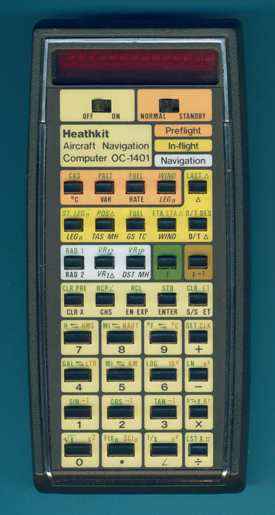
Heathkit Aircraft Navigation Computer OCW-1401
| Date of introduction: | 1978 | Display technology: | LED-modules |
| New price: | $169.95 / $274.95 | Display size: | 14 |
| Size: | 6.3" x 3.1" x
1.7" 161 x 80 x 44 mm3 |
||
| Weight: | 10.6 ounces, 302 grams | Serial No: | 37313 |
| Batteries: | 4*AA | Date of manufacture: | year 1979 |
| AC-Adapter: | Origin of manufacture: | USA | |
| Precision: | Integrated circuits: | 3 * Mostek MK3870 | |
| Memories: | |||
| Program steps: | Courtesy of: | Joerg Woerner | |
| Download manual: |  (US: 4.6M Bytes)
 |

 You
are right - there is no connection to Texas Instruments! But - to be honest -
it is one of the best engineered calculators.
You
are right - there is no connection to Texas Instruments! But - to be honest -
it is one of the best engineered calculators.
If we trace back the Aircraft Navigation Computers back to
their roots we locate two different approaches:
Simple models introduced around 1980 like the
Jeppesen Sanderson avstar or the
prostar
based on scientific calculators and more complex products like the USMC
HARRIER based on programmable calculators.
This OCW-1401 started already in the year 1978 a third approach: Powerful Navigation and nothing else! Later products like the Navtronic Explorer (1983) and the Jeppesen Sanderson Techstar (introduced 1992) continued these kind of products.
 You
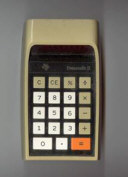
are familiar with this OCW-1401? Then you know the calculators sold by National
Semiconductors. On a first view the calculator looks like a scientific
calculator from National Semiconductor, e.g. the Model 4650. Indeed, the
keyboard and the display of them are identical.
You
are familiar with this OCW-1401? Then you know the calculators sold by National
Semiconductors. On a first view the calculator looks like a scientific
calculator from National Semiconductor, e.g. the Model 4650. Indeed, the
keyboard and the display of them are identical.
The OC-1401 was sold as kit, the OW-1401 was factory wired. Both included:
| • The calculator • A glare screen for the display. • A cigarette lighter plug for external power. • A hard case to protect the equipment. |
 Dismantling
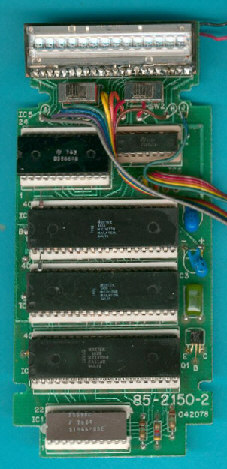
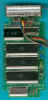
this Heathkit OC-1401 Aircraft Navigation Computer reveals the complexity of the
product. Three mask-programmed 8-bit single-chip microcomputers manufactured by
Mostek (MK3870-MK14103 to 14105) and three
other integrated circuits (Fairchild F3539, National
Semiconductors DS8664 and DS8667 display drivers) on a large printed circuit
board. To our knowledge the most complex pocket calculator ever produced - like
most Heathkit products it was sold as a kit! A factory assembled version was
available at $274.95. Find
more information about the MK3870 here.
Dismantling
this Heathkit OC-1401 Aircraft Navigation Computer reveals the complexity of the
product. Three mask-programmed 8-bit single-chip microcomputers manufactured by
Mostek (MK3870-MK14103 to 14105) and three
other integrated circuits (Fairchild F3539, National
Semiconductors DS8664 and DS8667 display drivers) on a large printed circuit
board. To our knowledge the most complex pocket calculator ever produced - like
most Heathkit products it was sold as a kit! A factory assembled version was
available at $274.95. Find
more information about the MK3870 here.
 More
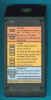
astonishing is the usage of the calculator. In comparison to other flight
computers you don't need a 100+ pages manual. Three modes are available:
More
astonishing is the usage of the calculator. In comparison to other flight
computers you don't need a 100+ pages manual. Three modes are available:
| • Preflight: You have to key in all preflight data with the
orange keys. Data is saved in standby mode while transport to airport. • In-flight: You set the time and key in all necessary data with the yellow keys. • Navigation: With the green keys you get all navigation data. |
If we trace back in the history of electronic flight computers we discover: The Commodore N-60, this Heathkit OCW-1401, the navtronic 16 and the Texas Instruments TI-58 (with installed Aviation Modul). Heathkit published a small comparison table:
| Features | Heathkit OCW-1401 | Commodore N 60 | Navtronics 16 | Texas Instr. TI-58 |
| Flight Leg Entries | Up to 9 | 1 | 1 | 1 |
| Continuous Data Update | YES | NO | NO | NO |
| Built-in Clock/Timer | YES | NO | NO | NO |
| Fuel Warning | YES | NO | NO | NO |
| Built-in Diagnostic | YES | NO | NO | NO |
| Scientific Functions | YES | YES | NO | YES |
| Internal Program Built-in | YES | YES | YES | NO |
| Price | $169.95 (KIT) | $99.00 | $197.50 | $149.95 |
All were introduced in or before 1978, two years before the Jeppesen Sanderson avstar based on a Texas Instruments TI-35 appeared.
Don't miss the Tamaya NC-77 Astro-Navigation Calculator!
Fairchild Semiconductor reached in June 1975 an agreement with Mostek to second-source the F8 8-bit microprocessor system and both companies worked in 1976 on combining the two-chip 3850/3851 solution into a single-chip Microcomputer with 2,048 Bytes of Program ROM. It was ironically Mostek who not only won the race with introducing their MK3870 a few weeks ahead of Fairchild's 3859, their MK3870 design was using a single +5V supply while the 3859 still relied on dual +5V/+12V supplies. Fairchild consequently dropped the 3859 and licensed instead the 3870 back from Mostek - becoming now the second source.
The MK3870 is a complete 8-bit microcomputer on a single MOS (Metal–oxide Semiconductor) integrated circuit. It is manufactured in a n-channel ion injection silicon-gate technology compared to the ion-implantation, depletion-mode load, p-channel MOS metal-gate process of the MK5020. The MK3870 can execute the F8 instruction set of more than 70 commands, allowing expansion into multi-chip configurations with software compatibility. The device features 2,048 bytes of ROM, 64 bytes of scratchpad RAM, a programmable binary timer and interrupt, 32 bits of TTL compatible I/O and a single +5 V power supply requirement.

If you have additions to the above article please email: joerg@datamath.org.
© Joerg Woerner, December 5, 2001. No reprints without written permission.