DATAMATH CALCULATOR MUSEUM
|
DATAMATH CALCULATOR MUSEUM |
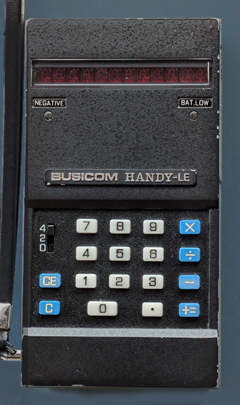
Busicom "HANDY-LE" LE-120A
| Date of introduction: | February 1971 | Display technology: | LED modules |
| New price: | $395 | Display size: | 12 + Sign |
| Size: | 4.8" x 2.6" x
0.8" 123 x 66 x 20 mm3 |
||
| Weight: | 7.2 ounces, 205 grams | Serial No: 046684 | 25HB100553 |
| Batteries: | 4*AA Alkaline | Date of manufacture: | mth 06 year 1971 |
| AC-Adapter: | Origin of manufacture: | Japan | |
| Precision: | 12 | Integrated circuits: | MK6010L |
| Logic: | Adding Machine | Displays: | 12*Monsanto MAN-3A |
| Memories: | |||
| Program steps: | Courtesy of: | Javier Orbaiceta |
 When Nippon Calculating Machine Corp of Japan, better known under their brand
Busicom, explored their options of using LSI (Large Scale Integration) PMOS (p-channel Metal–oxide Semiconductor) technology for their electronic calculators, they teamed up with two American Semiconductor companies:
When Nippon Calculating Machine Corp of Japan, better known under their brand
Busicom, explored their options of using LSI (Large Scale Integration) PMOS (p-channel Metal–oxide Semiconductor) technology for their electronic calculators, they teamed up with two American Semiconductor companies:
|
• Intel: Desktop calculators with programmable functionality – Up to 16 digits capacity with optional printer • Mostek: Compact desktop calculators with fixed functionality – Up to 12 digits capacity, non-printing or printing |
The cooperation with Intel resulted in the famous 4004, the World's first microprocessor, while Mostek's MK6010 is recognized as the World's first "single-chip calculator circuit".
Busicom's earliest electronic desktop calculators like the Model 161 (July 1966) and Model 141 (November 1967) were using a mix of SSI (Small Scale Integration) DTL (Diode-Transistor Logic), discrete transistors and diodes
plus a magnetic core memory and it was the Model 120-DA introduced in April 1969 paving the way for the MK6010 design. The Model 120-DA was Busicom's first design using JMOS technology, mostly simple SSI devices for the logic but a few MSI (Medium Scale Integration) chips sprinkled in for both the Serial BCD (Binary Coded Decimal) Adder and the 48-bit Shift Registers for number storage. The successor of the Model 120-DA - introduced in January 1970 and consequently named Model 120-DB - changed the decimal point switch from [0-1-2-3] to [0-2-3-4]. Within a few months, Busicom was able to squeeze the electronics of the Model 120-DB into a housing with roughly half the volume and the Model 120-DM, also known as Busicom Junior, was born. Its main electronics were distributed on two large printed circuit boards (PCBs), containing 22 Integrated Circuits
(ICs) in JMOS technology from Mitsubishi,
NEC and
Toshiba, complemented by around 220 discrete diodes and more than 100 resistors. It was the very same logic design that Busicom handed in Summer 1970 over to Mostek in Dallas, Texas; tasking the young company to integrate the circuitry
into a single chip manufactured in high-threshold, p-channel MOS technology, operating from
−12
Volts and −24 Volts.
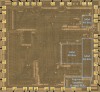 While Mostek originally estimated to be able to realize conversion of the circuitry from a mix of JMOS and Diode-Resistor logic to PMOS technology and provide the layout of the chip within a couple of weeks, the actual work took about three months and the first working samples of the MK6010 were manufactured in November 1970. The resulting chip is integrating more than 2,100 transistors in 360 gates plus 160 flip-flops and measures around 185 mils * 170 mils / 4.7 mm * 4.3 mm.
When Busicom finally introduced early in 1971 the second generation of the portable desktop calculator Model 120-DM or Junior, it looked at first glance identical to its predecessor but its housing is actually 0.5” (12 mm) slimmer due to the reduction from two large Logic-PCBs and the smaller Display-PCB to just one Main-PCB containing the MK6010 "single-chip calculator chip", the discrete keyboard interface, 12 low-voltage VF-Display tubes and the necessary transistors for the display. Neither the keyboard nor the power supply changed between the two iterations of the calculator.
Busicom realized the potential of applying Mostek's ion-implantation process to the chip design and the resulting MK6010L "low-voltage, low-power" version of the MK6010 allowed the design of this incredible LE-120A calculator.
The Busicom LE-120A is today credited with many "Firsts":
|
• First truly pocket-sized electronic calculator • First hand-held calculator using a "single-chip calculator circuit" • First use of an LED (Light-emitting Diode) display with an electronic calculator • First calculator operated with disposable batteries |
Unfortunately, the many "Firsts" did not immediately translate into a massive sales success as observed with the later Hewlett Packard HP-35 using the same playbook. The LE-120A with its unique metal-cast body and its 12-digit LED display was very expensive and when Busicom started lowering the manufacturing costs by switching to a plastic body (LE-120S), changing the display size to 10-digits (LE-100A) and even 8-digits (LE-80S, LE-80A, LE-80B); competition was already up and running and leading to the start of the "Calculator War" – with Busicom being in 1974 the first casualty of a Japanese calculator manufacturer.
As of May 2026, we have identified 7 members of the Handy series manufactured by Nippon Calculating Machine Corp. and sold under its Busicom brand, as well as white-labeled versions for National Cash Register (NCR) and Privileg (Quelle):
| Model | Introdution | Serial # | Size | Weight | Batteries | Display | PCB # | Calculator Chip |
NCR Model |
Privileg Model |
Notes |
| LE-120A | Feb. 1971 | 25_B1___ | 123 x 66 x 20 mm3 | 205 grams | 4*AA | 12 Digits 2 LEDs |
Mostek MK6010L |
Metal housing | |||
| LE-120S | Feb. 1972 | 27_B1___ | 124 x 67 x 25 mm3 | 135 grams | 4*AA | 12 Digits 2 LEDs |
Mostek MK6010L |
Plastic housing | |||
| LE-80S Version 1 |
47_B1___ | 124 x 67 x 25 mm3 | 126 grams | 4*AA | 8 Digits 3 LEDs |
PCB-0097 PCB-0098 |
Mostek MK6010L |
03988 47_Q |
8-digit LE-120S | ||
| LE-80S Version 2 |
52_B1___ | 126 x 67 x 25 mm3 | 129 grams | 4*AA | 8 Digits 3 LEDs |
PCB-0116 PCB-0098 |
Mostek MK6010L |
03988 52_Q |
Larger Keys | ||
| LE-80A | May 1972 | 35_B1___ | 81 x 56 x 21 mm3 | 74 grams | 4*NN | 8+1 Digits | QP-3809 QP-3811 |
TI TMS0105BNC |
|||
| LE-80B | tbd 1972 | 37_B1___ | 81 x 56 x 21 mm3 | 74 grams | 4*NN | 8+1 Digits | |
TI TMS0105BNC |
|||
| LE-100A | Sep. 1972 | 39_B1___ | 124 x 67 x 25 mm3 | 129 grams | 4*AA | 10+1 Digits | QP4601 | TI TMS0106NC |
CLASS 18-44 | 10-digit LE-120S |
In April 2026, Javier Orbaiceta shared with the Datamath Calculator Museum photographs of a fully working Busicom LE-120A HANDY that his father had purchased in Tokyo in 1971. Thank you!
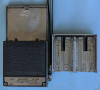
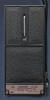 Dismantling
the featured Busicom "LE HANDY" LE-120A calculator manufactured in June 1971 in
Japan
reveals a masterpiece of engineering. The calculator's two-piece housing and detachable battery compartment are made of die-cast metal and contain three double-sided printed circuit boards
(PCBs):
Dismantling
the featured Busicom "LE HANDY" LE-120A calculator manufactured in June 1971 in
Japan
reveals a masterpiece of engineering. The calculator's two-piece housing and detachable battery compartment are made of die-cast metal and contain three double-sided printed circuit boards
(PCBs):
|
• Main-PCB - Mostek MK6010L single-chip calculator circuit, display driver and power supply • Display-PCB - Twelve 7-segment LED display modules, two indicator LEDs and current limiting resistors • Keyboard-PCB - Contacts for keys and sliding switch, discrete diodes for keyboard encoding |
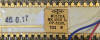 Calculating Unit:
Sprague Electric Company helped move ion-implantation from experimental research into practical semiconductor manufacturing. In collaboration with Mostek, the process was refined for large-scale production of integrated circuits.
Ion-implantation provided major advantages over older diffusion techniques by allowing precise control of dopants within silicon wafers. This precision enabled lower transistor threshold levels and reduced operating voltages, leading to lower power consumption and improved reliability.
Nippon Calculating Machine Corp., on the other hand, had developed its Busicom Model 120-DM using JMOS technology and requested that the MK6010 be designed with a high-threshold process so the existing power supply and display circuitry could be reused.
Calculating Unit:
Sprague Electric Company helped move ion-implantation from experimental research into practical semiconductor manufacturing. In collaboration with Mostek, the process was refined for large-scale production of integrated circuits.
Ion-implantation provided major advantages over older diffusion techniques by allowing precise control of dopants within silicon wafers. This precision enabled lower transistor threshold levels and reduced operating voltages, leading to lower power consumption and improved reliability.
Nippon Calculating Machine Corp., on the other hand, had developed its Busicom Model 120-DM using JMOS technology and requested that the MK6010 be designed with a high-threshold process so the existing power supply and display circuitry could be reused.
The MK6010L used in the Busicom LE-120A is a variant of Mostek's MK6010, the world's first single-chip calculator circuit, manufactured with an ion-implantation process to reduce the required supply voltages from −12 V and −24 V to −9 V and −16 V:
|
• November 1970 – Mostek
MK6010: −12 V and −24 V • June 1971 – Mostek MK6010L: −9 V and −16 V • June 1971 – General Instrument 250: −25 V • September 1971 – Texas Instruments TMS1802: −7.2 V and −14.4 V |
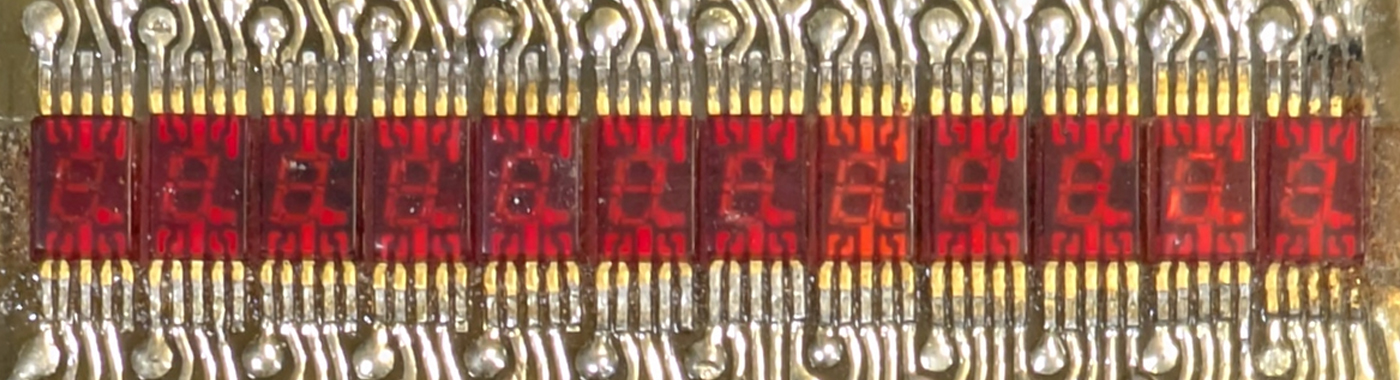 Display:
The featured Busicom LE-120A calculator, manufactured in June 1971, utilizes a 12-digit LED display assembly composed of twelve Monsanto MAN-3A seven-segment LED displays housed in flat-pack packages and manually soldered onto
the double-sided Display-PCB. In addition to the numeric displays, the Display-PCB incorporates two indicator LEDs for negative values and low-battery status, as well as the associated current-limiting resistors. The
Display-PCB is connected to the Main-PCB of the LE-120A by 24 short wires that are soldered directly between the two boards.
Display:
The featured Busicom LE-120A calculator, manufactured in June 1971, utilizes a 12-digit LED display assembly composed of twelve Monsanto MAN-3A seven-segment LED displays housed in flat-pack packages and manually soldered onto
the double-sided Display-PCB. In addition to the numeric displays, the Display-PCB incorporates two indicator LEDs for negative values and low-battery status, as well as the associated current-limiting resistors. The
Display-PCB is connected to the Main-PCB of the LE-120A by 24 short wires that are soldered directly between the two boards.
Display Driver: The MK6010L single-chip calculator circuit and its
companion, the MK6010, originated from the architecture of the Busicom Model 120-DM desktop calculator, better known as the Busicom
Junior. This calculator was built from 22 JMOS integrated circuits and featured
low-voltage vacuum fluorescent displays (VFDs). To facilitate display
interfacing, the designers chose a negative-logic configuration for the digit
and segment outputs, enabling straightforward drive circuitry based on discrete
transistors. This design philosophy was carried over to the MK6010 and MK6010L.
Consequently, both devices provide negative-logic digit and segment outputs,
requiring PNP bipolar junction transistors (BJTs) to drive the anodes and
cathodes of the 12-digit LED display.
The necessary discrete transistors are arranged on the Main-PCB of the LE-120A
calculator.
Clock: The MK6010L single-chip calculator circuit used in the Busicom LE-120A operates from a two-phase clock running at approximately 20 to 25 kHz. The clock signal is generated by an astable multivibrator consisting of four BJTs, which is located on the calculator's
Main-PCB.
Power Supply: The Busicom LE-120A calculator is powered by four
disposable AA-size 1.5 V alkaline batteries. A simple DC/DC converter generates
two additional negative supply voltages required by the MK6010L calculator chip:
|
• VSS - Positive supply for MK6010L (+6.0 V) from batteries • GND - Negative supply for LED Display (0 V) from batteries • VDD - Negative supply for MK6010L (-3.0 V) from DC/DC converter • VGG - Negative supply for MK6010L (-10.0 V) from DC/DC converter |
Calculating the power consumption at 6 Volts for the Busicom LE-120A results in about 550 mW displaying a '0' and about 1,200 mW with all segments illuminated.
Keyboard:
The keyboard assembly of the Busicom LE-120A uses 17
plastic keys pushing individual metal fingers soldered on a double-sided PCB against
large, gold-plated contacts mounted on the PCB and a 3-position sliding switch
to select the position of the decimal point. The compact Keyboard-PCB incorporates 14 discrete diodes to convert the numeric key inputs into the BCD-encoding required by the MK6010L calculator
chip. In addition, the board contains a number of discrete resistors and
capacitors used for the keyboard interface circuitry.
Following the bankruptcy of Busicom in Japan in 1974, the rights to the Busicom trade name were acquired by the British business machine company Broughtons & Co. (Bristol) Ltd. The company subsequently continued to market and service business machines under the Busicom brand in the United Kingdom.

If you have additions to the above article please email: joerg@datamath.org.
© Joerg Woerner, May 26, 2026. No reprints without written permission.