DATAMATH CALCULATOR MUSEUM
|
DATAMATH CALCULATOR MUSEUM |
While Jack Kilby of Texas Instruments invented the Integrated Circuit (IC) in September 1958, it was Robert Noyce who, in 1959, made IC manufacturing more practical during his time at Fairchild Semiconductor. Fairchild's "planar process", developed by Jean Hoerni, was eventually adopted by all chip manufacturers. As a result, Kilby and Noyce are now widely regarded as co-inventors of microchip technology.
Fairchild Semiconductor pioneered MOS (Metal-oxide Semiconductor) technology in the 1960s, but failed to capitalize on the late-1960s market shift toward MOS, allowing spin-off firms founded by former employees ("Fairchildren") to take the lead in its commercial adoption.
Founded in 1963 by ex-Fairchild Semiconductor personnel, General Micro-electronics (GMe) became the first firm to design, manufacture, and market commercial MOS integrated circuits, producing early complex devices such as the PicoLogic pL-20 shift register in August 1964. In 1965, General Micro-electronics designed the Integrated Circuits for the Victor 3900, widely regarded as the first all-MOS calculator.
It must have been a shockwave for a handful of Japanese companies, when Texas Instruments demonstrated in 1967 with the Cal-Tech feasibility study for the first time the application of LSI (Large Scale Integration) chips for portable, battery-operated calculators. American companies not only invented the transistors and ICs (Integrated Circuits) used with electronic calculators in the second half of the 1960s, but they also had a lead in the design and manufacturing of chips using PMOS (p-channel Metal–oxide Semiconductor) technology. On the other hand, Japanese companies like Canon, Casio, Sanyo, Sharp and Toshiba almost completely owned in 1967 the market of electronic desktop calculators and successfully developed, manufactured and sold their products designed around transistors and ICs.
The major manufacturers of electronic desktop calculators acted swiftly and locked into relationships with chips manufacturers capable of designing and producing PMOS LSI devices. In a first wave, around 1969/1970, three successful results of these collaborations hit the market:
|
• October 1969 - Sharp
QT-8D, Rockwell Chipset • April 1970 - Canon Pocketronic, Texas Instruments Chipset • May 1970 - Sanyo ICC-82D, General Instrument Chipset |
The second wave of partnerships between Japanese desktop calculator manufacturers and American chip manufacturers can be identified with:
|
• Busicom 141-PF, Intel Chipset (Famous 4004 microprocessor) • Busicom Handy LE-120, Mostek Chip • Toshiba BC-1215/BC-1216P, American Microsystems, Inc. (AMI) Chipset |
Fairchild Semiconductor was largely absent from the booming electronic calculator market; only three known development efforts in PMOS/LSI technology were directed toward what had become in the early 1970s a dominant application area:
|
• Micromosaic - MOS Standard Cell technology • PPS 25 - Building Blocks for Scientific Calculator • SPRINT - Building Blocks for Accounting Calculator |
In 1969, Fairchild Semiconductor introduced its Micromosaic products, originally developed for GE's Avionics and pioneering so-called "standard cell" technology - a design methodology for Application Specific Integrated Circuits (ASICs) based on pre-designed, pre-characterized dynamic logic blocks (such as AND, OR, shift registers, RAM, ROM). These cells, arranged in rows with fixed height and variable width, could be automatically interconnected, enabling a balance between high performance and efficient fabrication.
Fairchild's customers handled the high-level logic design, partitioned the logic into Micromosaic chips, selected the appropriate Micromosaic cells, and performed logic and timing simulations. Fairchild then created the wafer masks and handled packaging and testing of the Integrated Circuits.
Only a few Full-custom Micromosaic designs made it into electronic calculators:
| Type | Year | Function | Calculators | Comments |
| SL35021 | 1970 | Casio 121K, 161K, AS-C, Remington EDC-1203, EDC-1603 | 40-pin Ceramic or Plastic DIP | |
| SL35022 | 1970 | Casio 121K, 161K, AS-C, Remington EDC-1203, EDC-1603 | 40-pin Ceramic or Plastic DIP | |
| SL35023 | 1970 | Casio 121K, 161K, AS-C, Remington EDC-1203, EDC-1603 | 40-pin Ceramic or Plastic DIP | |
| SL35024 | 1970 | Casio 121K, 161K, AS-C, Remington EDC-1203, EDC-1603 | 40-pin Ceramic or Plastic DIP | |
| SL35025 | 1970 | Casio AS-C, Remington EDC-1203, EDC-1603 | 16-pin Ceramic DIP | |
| SL35085 | 1971 | Litton Royal IC-130 | 40-pin Ceramic DIP | |
| SL35090 | 1971 | 40-pin Ceramic DIP |
Fairchild Semiconductor developed early in the 1970s with the PPS 25 a family of micro-programmed MOS/LSI (Metal–oxide Semiconductor/Large Scale Integration) processor blocks to bridge the gap between simple electronic calculators and microcomputers. The PPS 25 adopts a Harvard architecture and utilizes dynamic 25-digit shift registers for its data storage, enabling both precise and fast mathematical operations. The PPS 25 Building Blocks are based on Fairchild's Micromosaic "standard cell" technology. This design methodology for application-specific integrated circuits (ASICs) is based on pre-designed, pre-characterized dynamic logic blocks (such as AND, OR, shift registers, RAM, ROM). These cells, arranged in rows with fixed height and variable width, could be automatically interconnected, enabling a balance between high performance and efficient fabrication.
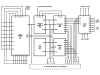 A minimal PPS 25 design uses six Micromosaic chips interconnected by 4-bit data buses and various control signals, corresponding directly to the block diagram of a computer based on the Harvard architecture.
At the core of the system is the CPU, composed of the 3805 Arithmetic/Logic Unit and the 3806 Control Unit. The 3808 and 3809 Data Memories each provide three dynamic 25-digit shift registers, while the 3810 Program Memory provides 256 Words * 12 Bits of storage. The 3803 and 3807 Input Device chips support up to 32 keys and 16 switches each, and the 3811 Output Device drives displays of up to 16 Digits.
As of today, we are aware of only one PPS 25-based design that comes close to an electronic calculator; however, it is at least used in classrooms:
| Type | Year | Function | Products | Comments |
| 3805 | 1973 | Arithmetic Chip |
Centurion Industries Multiputer CPD-15, CPD-35 Cybernetic Systems Mathiputer CPD-15, CPD-35 |
18-pin Ceramic DIP |
| 3806 (SL30342) | Function and Timing Unit | 24-pin Ceramic DIP | ||
| 3807 | Input Device | 40-pin Ceramic or Plastic DIP | ||
| 3809 | Memory Register | 16-pin Ceramic DIP | ||
| 3810 (SL30745) | ROM | 16-pin Ceramic DIP | ||
| 3811 | Output Device | 24-pin Ceramic DIP |
The PPS 25 (Programmed Processor System - 25 Digits) was de-emphasized by Fairchild Semiconductor around 1974 in favor of the F8 8-bit Microprocessor System.
The SPRINT Accounting Calculator Set provides the functionality of a basic 8-digit calculator with fixed-point arithmetic, rounded percentage, constant and memory functions. It was introduced in 1972 but never commercialized.
The proposed calculator design made use of five Micromosaic chips, each providing an array of 80 gates in PMOS (p-channel Metal–oxide Semiconductor) technology:
| Type | Year | Function | Products | Comments |
| 3820 | 1972 | Keyboard Interface | tbd | 40-pin Ceramic DIP |
| 3821 | Segment Outputs | 40-pin Ceramic DIP | ||
| 3822 | Digit Outputs | 40-pin Ceramic DIP | ||
| 3823 | Timing Unit | 16-pin Ceramic DIP | ||
| 3824 | Adder/Subtractor | 24-pin Ceramic DIP |
The Fairchild F8 8-bit microprocessor system was announced in September 1974 and shipped in April 1975. A minimal system was using just two 40-pin chips manufactured in NMOS (n-channel Metal–oxide Semiconductor) SGT (Silicon Gate Technology):
|
• 3850 - CPU (Central
Processing Unit) with ALU (Arithmetic Logic Unit), 64 Bytes RAM (Random Access Memory) and two 8-bit-bi-directional I/O ports • 3851 - Program Storage Unit (PSU) with 1,024 Bytes Program ROM (Read-only Memory), instruction decoding and two 8-bit-bi-directional I/O ports |
Fairchild's customers could develop the firmware of the F8 microprocessor system while Fairchild created the wafer masks and handled packaging and testing of the chips. As of today, we are aware of only one successful F8 design for electronic calculators – more precisely a classroom teaching device:
| Type | Year | Function | Products | Comments |
| 3850-1 | 1975 | 8-bit CPU, 64 Bytes RAM, 2 * 8-bit IO | Cybernetic Systems Mathiputer CPD-44 | 40-pin Ceramic or Plastic DIP |
| 3851 (SL31190) | 1,024 Bytes Program ROM, 2 * 8-bit IO | 40-pin Ceramic or Plastic DIP |
Fairchild Semiconductor reached in June 1975 an agreement with Mostek to second-source the F8 8-bit microprocessor system and both companies worked in 1976 on combining the two-chip 3850/3851 solution into a single-chip Microcomputer with 2,048 Bytes of Program ROM. It was ironically Mostek who not only won the race with introducing their MK3870 a few weeks ahead of Fairchild's 3859, their MK3870 design was using a single +5V supply while the 3859 still relied on dual +5V/+12V supplies. Fairchild consequently dropped the 3859 and licensed instead the 3870 back from Mostek - becoming now the second source:
| Type | Year | Function | Calculators | Comments |
| 3859 | 1977 | 8-bit CPU, 2,048 Bytes Program ROM64 Bytes RAM, 4 * 8-bit IO | 40-pin Ceramic or Plastic DIP, +5V/+12V supplies | |
| 3870 | 1977 | 8-bit CPU, 2,048 Bytes Program ROM64 Bytes RAM, 4 * 8-bit IO | Heathkit OCW-1401 | Second source of Mostek MK3870 40-pin Ceramic or Plastic DIP, +5V supply |
These chips are manufactured in a metal-gate p-channel MOS (3800-3804), silicon-gate p-channel MOS (3814-3816), isoplanar n-channel MOS (3817) or silicon-gate CMOS (3819) process and using Dual-Inline-Ceramic (CDIP) of Plastic (DIP) packages with 16 to 40 pins.
| Type | Year | Function | Products | Comments |
| 3800 | 1971 | 8-bit Parallel Accumulator | 40-pin Ceramic or Plastic DIP, -13V/-27V supplies | |
| 3801 | 1971 | 10-bit Serial-Parallel, Parallel-Serial Register/Converter | 40-pin Ceramic or Plastic DIP, -27V supply | |
| 3802 | 1971 | Dual Rank Buffer Register | ||
| 3804 | 1971 | 4-Bit Arithmetic Unit (Basic CPU Element) | ||
| 3814 | 1972 | 4½-Decade Digital Voltmeter Logic | 24-pin Ceramic or Plastic DIP, +5V/-12V supplies | |
| 3815 | 1972 | 5-Decade Counter | 24-pin Ceramic or Plastic DIP, +5V/-12V supplies | |
| 3816 | 1972 | 3 to 262,145 Programmable Counter | 16-pin Ceramic or Plastic DIP, +5V/-12V supplies | |
| 3817 | 1972 | Digital Clock | ||
| 3819 | 1973 | Digital Wristwatch Circuit |
The numbering scheme used to mark Integrated Circuits (ICs) manufactured by Fairchild Semiconductor changed multiple times and here at the Datamath Calculator Museum we focus on the timeframe between 1964 and about 1979, the peak of Fairchild's engagement in supplying Bipolar and MOS (Metal-oxide Semiconductor) chips for electronic calculators.
Part numbering of Integrated Circuits is a complex topic, and one needs to look into it under different angles. The package of the housing contains one set of information while the silicon die inside the encapsulations holds another set of information. The package, both its top and bottom sides typically bear a manufacturer identification, product identification number, device revision, manufacturing date, manufacturing/packaging site, temperature rating, speed rating, and more. None of this labeling information is standardized and most companies create their own coding scheme. With the number of chip designs growing exponentially over time, Fairchild changed their part numbering multiple times.
Fairchild used with their very first commercially available ICs the leading µ for Micro and the following letter defined with the leading numeral of the 3-digit Product Identification Number the Family Type:
| • µA700 - Linear Integrated Circuits • µL900 - RTL (Resistor-Transistor Micrologic) |
With the introduction of the the 930 Diode-Transistor Micrologic in 1964, Fairchild changed the marking of the chips slightly:
| • 930 DTµL - Diode-Transistor Micrologic |
In a next step, the 3-digit Product Identification Number was increased to 4-digits with an optional modifier before in 1974 Fairchild moved to 5-digit numbers and adopting "standard numbers".
Integrated Circuits manufactured by Fairchild in the early 1970s are typically using three markings on top of the chip packaging:
| • F - Manufacturer Identification • xxxxXZV - Product Identification • yyww - Date Code |
and most Digit Integrated Circuits manufactured till mid-1970s are using the following Numbering System:
| • 1000 - Custom Integrated Circuits • 1000 - Custom Integrated Circuits • 3000 - MOS Intergrated Circuits • 3100 - SSI PMOS (-27 V) • 3250 - MOS ROM • 3300 - MOS Shift Register • 3500 - MOS RAM/ROM • 3700 - MOS Analog (Switches, Multiplexer, A/D and D/A Converter) • 3800 - MOS LSI Logic • 3850 - F8 CPU Systems • 4000 - Micromatrix Integrated Circuits • 4500 - 8 Cells Micromatrix DTuL • 4600 - 48 Gates Micromatrix TTuL • 4700 - 96 Gates Micromatrix TTuL • 5000 - Second Source Integrated Circuits • 9000 - Digital Integrated Circuits • 9000 - TTuL (Transistor-Transistor Micrologic) • 9030 - MuL (Memory Micrologic) • 9040 - LPDTµL (Low-Power Diode-Transistor Micrologic) • 9090 - LPDTµL (Low-Power Diode-Transistor Micrologic) • 9100 - HLLDTuL (High-Level Logic Diode-Transistor Micrologic) • 9300 - MSI TTuL (Medium Scale Integration Transistor-Transistor Micrologic) • 9400 - STTuL (Schottky Transistor-Transistor Micrologic) • 9500 - ECL (Emitter-Coupled Logic) • 9600 - Mixed-Signal TTuL (Monoflops, Line Receiver etc) • 9900 - RTµL (Resistor-Transistor Micrologic) • 9950 - CTuL (Complementary Transistor Micrologic) |
Package Type:
|
• D Ceramic DIP (Hermetic) • F Flatpak (Hermetic) • H Metal Can Package • P Plastic DIP • T Mini DIP (Molded) |
Temperature Range:
|
• C 0°C to +70°C (Commercial MOS) • L -550°C to +85°C (Limited military) • M -55°C to +125°C (Military) |
A typical single-chip calculator circuit from NEC manufactured in 1974 might read NEC µPD940C H5728M:
| • MOS Digital IC, 940, Plastic DIP • H5728M is a production lot/date code, we assume that 5 represents the year 1975 and 7 the month July |
Photomask Revision:
|
• _ Original Mask set • Z Revision 1 • Y Revision 2 etc. |
| • 1970 - 15 um metal gate PMOS, enhancement mode transistors for gates and loads • 1972 - 12 um metal gate PMOS, enhancement mode transistors for gates and loads • 1975 - 10 um silicon gate PMOS, enhancement mode transistors for gates, depletion mode transistors for loads |

If you have additions to the above article please email: joerg@datamath.org.
© Joerg Woerner, May 10, 2026. No reprints without written permission.