DATAMATH CALCULATOR MUSEUM
|
DATAMATH CALCULATOR MUSEUM |
Texas Instruments TI-88 (PVT 4)
| Date of introduction: | Never (Announced: May 26, 1982 Cancelled: September 10, 1982) |
Display technology: | LCD dot matrix |
| New price: | MSRP: $350.00 | Display size: | 10 (8 + 2) |
| Size: | 6.2" x 3.3" x
1.6" 157 x 85 x 41 mm3 |
||
| Weight: | 8.3 ounces, 236 grams | Serial No: | 0002023 |
| Batteries: | BP88 (1*AA-NiCd) | Date of manufacture: | wk 33 year 1982 |
| AC-Adapter: | AC9133 | Origin of manufacture: | USA (ATA) |
| Precision: | 13 | Integrated circuits: | TP0485
(CD2901),
TP0485 (CD2902),
2*TP0530, 2*TP0531, TP0532 (CD5402), SN77203 |
| Memories: | 120-0 | ||
| Program steps: | 0-960 | Courtesy of: | Joerg Woerner |
| Download product announcement: |  (US: 2.1M Bytes)
 |
Download manual - PREVIEW ONLY: |
(US: 4.2M Bytes) |
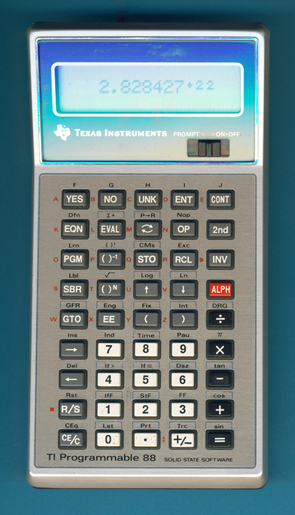


 We
wrote May 1982 when Texas Instruments printed
the sales brochures of the TI-88 on glossy paper. The brochures promised the introduction
of the TI-58C/TI-59
successor for Forth Quarter 1982 in a package matching the TI-55-II
line - before we got word of the
TI-66. Today we know more: The development of the TI-88 was
finalized, the manuals printed, the first pre-production calculators worked
perfectly and Texas Instruments canceled the whole project! Maybe one of the reasons
was the introduction of the powerful Hewlett-Packard
HP-41C
calculator or the innovative Sharp PC-1211 Pocket Computer. Or the underestimated complexity of the TI-88 design. Or
electrostatic discharge (ESD) issues of the Module contacts. Or the internal
competition with the CC 40 Compact
Computer. Or the keyboard problems encountered with the TI-55-II family of
calculators. Or the decision of a Manager of TI's Consumer Electronic group to
quit the calculator business...
We
wrote May 1982 when Texas Instruments printed
the sales brochures of the TI-88 on glossy paper. The brochures promised the introduction
of the TI-58C/TI-59
successor for Forth Quarter 1982 in a package matching the TI-55-II
line - before we got word of the
TI-66. Today we know more: The development of the TI-88 was
finalized, the manuals printed, the first pre-production calculators worked
perfectly and Texas Instruments canceled the whole project! Maybe one of the reasons
was the introduction of the powerful Hewlett-Packard
HP-41C
calculator or the innovative Sharp PC-1211 Pocket Computer. Or the underestimated complexity of the TI-88 design. Or
electrostatic discharge (ESD) issues of the Module contacts. Or the internal
competition with the CC 40 Compact
Computer. Or the keyboard problems encountered with the TI-55-II family of
calculators. Or the decision of a Manager of TI's Consumer Electronic group to
quit the calculator business...
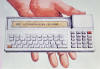
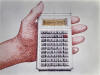 Learn more about the demanding "Project
X" initiated already in Summer 1977 and leading not only to the (failed) TI
Programmable 88, but the TI-66 PROGRAMMABLE,
failed TI-76 PROGRAMMABLE, Compact Computer
CC 40, (failed Compact Computer CC 70)
and last but not least the successful TI-74
BASICALC and TI-95 PROCALC.
Learn more about the demanding "Project
X" initiated already in Summer 1977 and leading not only to the (failed) TI
Programmable 88, but the TI-66 PROGRAMMABLE,
failed TI-76 PROGRAMMABLE, Compact Computer
CC 40, (failed Compact Computer CC 70)
and last but not least the successful TI-74
BASICALC and TI-95 PROCALC.
As of today we researched
almost twenty different TI-88 calculators with twelve different Builds or modifications (learn more about the
Five Engineering Stages):
| Owner | Serial Number | Build: | Date of Manufacture |
| Joerg Woerner | 9-26-81-35 | Design Validation Test 1 | ATA wk 39 year 1981 |
| Joerg Woerner | 9-26-81-43 | Design Validation Test 2 | ATA wk 39 year 1981 |
| Heinz Nixdorf Forum | t.b.d. | Design Validation Test 2 | t.b.d. |
| Joerg Woerner | --- | Clear-Case DVT 3 | ATA wk 04 year 1982 |
| Joerg Woerner | 0000049 | Design Validation Test 3 | ATA wk (01)51 year 1981 |
| Joao Oliveira | NTC-3-4-30-82 | Engineering Validation Test 1 | ATA wk 17 year 1982 |
| Joerg Woerner | --- | Production Validation Test 1 | ATA wk 21 year 1982 |
| Joerg Woerner | 0000337 | Production Validation Test 1 | ATA wk 21 year 1982 |
| Joerg Woerner | 0000452 | Production Validation Test 1 | ATA wk 21 year 1982 |
| Gene Wright | 0000261 | Production Validation Test 1.5 | ATA wk 20 year 1982 |
| Thierry Bru | 0000341 | Production Validation Test 1.5 | ATA wk 21 year 1982 |
| Joerg Woerner | 02 693 | Firmware Engineering Device | ATA wk 21 year 1982 |
| Viktor T. Toth | 0001101 | Production Validation Test 2 | ATA wk 32 year 1982 |
| Joerg Woerner | 0001073 | Production Validation Test 3 | ATA wk 32 year 1982 |
| Known | --- | Clear-Case PVT 4 | ATA wk 33 year 1982 |
| Joerg Woerner | 0002023 | Production Validation Test 4 | ATA wk 33 year 1982 |
| Luis Gómez | 0002055 | Production Validation Test 4 | ATA wk 33 year 1982 |
| Monty McGraw | 0002069 | Production Validation Test 4 | ATA wk 33 year 1982 |
| Smithsonian Institute | 0002074 | Production Validation Test 4 | ATA wk 33 year 1982 |
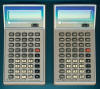
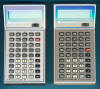 Just looking at the keyboard of the TI-88, you can easily
differentiate between the three Engineering Stages identified so far:
Just looking at the keyboard of the TI-88, you can easily
differentiate between the three Engineering Stages identified so far:
| [ALPH] Key | [R/S] Key | Build: | Notes |
 |
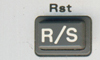 |
Design Validation Test | Grey [ALPH] key No dot next to [R/S] key |
 |
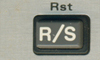 |
Engineering Validation Test | Red [ALPH] key No dot next to [R/S] key |
 |
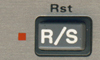 |
Production Validation Test | Red [ALPH] key Red dot next to [R/S] key |
 Please be aware that the
faceplates of most of the surviving
TI-88s were updated to the Production Validation Test design and the most
reliable indicator of the Three-and a-Half Main Engineering Stages can be found with the
Revision Number located on the printed circuit board (PCB):
Please be aware that the
faceplates of most of the surviving
TI-88s were updated to the Production Validation Test design and the most
reliable indicator of the Three-and a-Half Main Engineering Stages can be found with the
Revision Number located on the printed circuit board (PCB):
| • PCB 3500: Design Validation Test DVT 1, DVT 2,
DVT 3 • PCB 7999: Engineering Validation Test EVT 1 • PCB 8000: Engineering Validation Test PVT 1, PVT 1.5 • PCB 8449: Production Validation Test PVT 2, PVT 3, PVT 4 |
If you are interested in the subtle differences between the ten different builds discovered as of today, please follow this link.
Compared with the TI-58C you'll notice some differences and similarities:
| • The display is alphanumeric and prompts system messages in
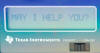
readable English. • The Constant Memory™ covers program and user memory. • The Solid State Software™ concept allows the expansion of two cartridges, either application programs (CROM) or user memory (CRAM). • Beside the traditional key-stroke programming, a formula mode is available. • A real time clock adds time and date. • A small speaker generates sounds. • A printer port accepts the PC-800 printer. • A Cassette Interface CA-800 allows the permanent storage of both programs and data with a tape recorder. |


 It is a pity that the TI-88
with the perfect prompting system never made it to the market. The next
calculators in the "Programmable/Scientific line" are the TI-95 PROCALC and
the first
Graphing calculator TI-81.
It is a pity that the TI-88
with the perfect prompting system never made it to the market. The next
calculators in the "Programmable/Scientific line" are the TI-95 PROCALC and
the first
Graphing calculator TI-81.
A Texas Instruments price list printed in July 1982 suggested
these MSRPs:
| Product | MSRP (July 1982) |
|
TI-88 Programmable Calculator |
$350.00 |
|
PC-800 Printer |
$185.00 |
|
CA-800 Cassette Interface |
$60.00 |
|
Constant Memory Modules CRAM |
$50.00 |
|
Solid State Software Modules CROM |
$40.00 |
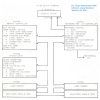 In 2002 the Patent application US4,447,881
filed by Texas Instruments in 1980 was discovered by Juergen
Dobrinski and in 2020 a binder labeled "Project X" including schematics of a
"Product 225 TI-85" from the estate of CB Wilson was located by Jon Guidry and made
available on his website www.hexbus.com. Together with hours and hours of reverse engineering based on the inside views of the
five different TI-88 builds discovered so far and looking into various CRAM and CROM Modules, we understand the
TI-88 calculator architecture pretty well. The design is centered around a 4-bit microcontroller
of the TP0485 family called Master Controller with
an associated TP0485 4-bit controller responsible for
Timekeeping, Key Scan and I/O functions supported by both ROM (Read Only Memory), RAM
(Read/Write Memory) and Display Drivers. We know a similar approach with two controllers
already with the TI-55 II.
In 2002 the Patent application US4,447,881
filed by Texas Instruments in 1980 was discovered by Juergen
Dobrinski and in 2020 a binder labeled "Project X" including schematics of a
"Product 225 TI-85" from the estate of CB Wilson was located by Jon Guidry and made
available on his website www.hexbus.com. Together with hours and hours of reverse engineering based on the inside views of the
five different TI-88 builds discovered so far and looking into various CRAM and CROM Modules, we understand the
TI-88 calculator architecture pretty well. The design is centered around a 4-bit microcontroller
of the TP0485 family called Master Controller with
an associated TP0485 4-bit controller responsible for
Timekeeping, Key Scan and I/O functions supported by both ROM (Read Only Memory), RAM
(Read/Write Memory) and Display Drivers. We know a similar approach with two controllers
already with the TI-55 II.
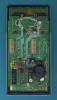
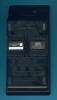
 Dismantling this TI-88 from the final PVT
4 (Production
Validation Test 4) series manufactured in August 1982 by Texas Instruments in
their Abilene, TX facility, reveals a design using the following main
components:
Dismantling this TI-88 from the final PVT
4 (Production
Validation Test 4) series manufactured in August 1982 by Texas Instruments in
their Abilene, TX facility, reveals a design using the following main
components:
| •
CD2901 (TP0485) Timekeeping, Key Scan and I/O
Controller • CD2902 (TP0485) Master Controller • 2*TP0530 Cascadable Display Drivers • 2*TP0531 On-board Read/Write Memories • CD5402 (TP0532) On-board Read Only Memory • Plug-in Memories which may be either Read Only Memory or Read/Write Memory • SN77203 Display Interface Voltage Controller Chip |
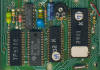
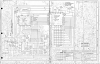
 The Schematics
Diagram from the Patent application of "Product X", leading over "Product
225 TI-85" to
the final TI-88 design, omits unfortunately the chip numbers but
we could reverse engineer them accordingly.
The Schematics
Diagram from the Patent application of "Product X", leading over "Product
225 TI-85" to
the final TI-88 design, omits unfortunately the chip numbers but
we could reverse engineer them accordingly.
MCU (Microcomputer Unit): The TI-88 is based on two TP0485 chips, a complete reversal of the legendary TMC0500 chip set for scientific calculators introduced in 1975 with the SR-50 and used for TI’s flagship calculators TI-59 and SR-60A till the mid of the Eighties and its spiritual successor TMC1500 used with the TI-57. While the TMC0501 Arithmetic Chip needed in a minimum configuration one extra TMC0520/530 SCOM (Scanning and Read Only Memory) or TMC0580 DSCOM (Scanning and Read Only Memory with double capacity) chip, integrated the LCD III microcontroller family both RAM and ROM allowing a single-chip configuration. The “register processor” architecture of both the TMC0500 and TMC1500 was highly optimized for arithmetic calculations used with scientific calculators and lacked flexibility for performing other tasks. The “digit processor” architecture of the LCD III on the other hand is based on a more flexible 4-bit architecture derived from the TMS1000 but optimized for fast processing speed and high modularity.
The TP0485 is a member of the LCD III family and the final evolution before the design was cancelled together with the TI-88:
| • TP0470: 3k*13 Bits ROM in 3 banks, 128*13
Bits Fast ROM, 22*16*4
Bits RAM, no LCD Driver • TP0475: 3k*13 Bits ROM in 3 banks, 128*13 Bits Fast ROM, 22*16*4 Bits RAM, Timekeeper, no LCD Drives • TP0485: 3k*13 Bits ROM in 3 banks, 128*13 Bits Fast ROM, 22*16*4 Bits RAM, Timekeeper, LCD Drives |
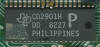
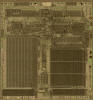 These chips can be bonded either in a 0.4” wide 28-pin SPDIP (Shrink Plastic Dual In-line Package with a 0.07” / 1.778 mm lead pitch) or a 0.6” wide 40-pin SPDIP encapsulation.
The planned product portfolio of the LCD III family included devices with smaller ROM capacity (1k*13
Bits or 2k*13 Bits) and RAM capacity intended for use in different products like the TI-55 II or even simple 4-banger calculators like the
TI-1030, but these chips never materialized.
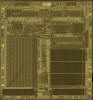 The TI-88 divides the various software and hardware
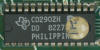
tasks into the TP0485/CD2902 Master Controller (sometimes called Memory Controller) with a 28-pin package and a TP0485/CD2901 Timekeeping, Key Scan and I/O Controller with a 40-pin package.
The TI-88 divides the various software and hardware
tasks into the TP0485/CD2902 Master Controller (sometimes called Memory Controller) with a 28-pin package and a TP0485/CD2901 Timekeeping, Key Scan and I/O Controller with a 40-pin package.
• TP0485/CD2901
| • Keyboard Control (Scan, Key Buffering, Key Encoding) • Display Loading • Timekeeping • Arithmetic Functions / AOS • Peripheral I/O • Controls HS Clock • Controls On/Off/Display States |
• TP0485/CD2902
| • Key Decode • User Memory Access (User Data Registers, User Program Steps) • User Program Run Mode (Label Search, Conditional Tests, Subroutine Control, Trace) • SSS Run Mode • Learn Mode |
Communication between the two TP0485 microcomputers and additional RAM and ROM devices is realized with a bidirectional 4-bit bus with up to 266k Bit/s while communication to the dot matrix LC-Display is using a serial approach. The peripheral I/O connects either to external devices like printer and cassette interface or another TI-88 calculator with a serial, bidirectional bus allowing between 1.2k Bit/s and about 2.0k Bit/s.
CROM (Customer Read Only Memory): The TI-58 and TI-59 programmable calculators introduced a novelty, the Solid State Software Modules with up to 5,000 program steps that could be inserted by the user through an opening called “port” on the backside of the calculators and covered by a small lid. The Master Library module was included with the calculators, 12 additional SSSM covering various applications were available from Texas Instruments and probably 50 to 100 modules from third-party companies.
The TI-88 continues this approach but expanded it in three dimensions:.
| • The calculator sports two ports and can host two modules simultaneously • The modules can contain either CROM or CRAM (Customer Random Access Memory with back-up battery) • The CRAM (TP0531) and CROM (TP0532) chips are used not only in the Modules but on the printed circuit board of the calculators, too |
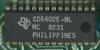
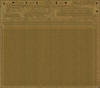 This TI-88 manufactured in August 1982 makes use of one TP0532/CD5402 chip with a capacity of 120,000
Bits organized as 15,000 Bytes and using a bidirectional 4-bit bus to communicate with the TP0485/CD2902 Master Controller. While only 10 pins are connected to the outside world is the TP0532 CROM packaged in a 0.4” wide 28-pin SPDIP housing.
This TI-88 manufactured in August 1982 makes use of one TP0532/CD5402 chip with a capacity of 120,000
Bits organized as 15,000 Bytes and using a bidirectional 4-bit bus to communicate with the TP0485/CD2902 Master Controller. While only 10 pins are connected to the outside world is the TP0532 CROM packaged in a 0.4” wide 28-pin SPDIP housing.
The TI-88 architecture uses a very clever approach of distributing program code in the different ROMs:
| • Very time-critical routines like adding two numbers are stored in the 128*13
Bits Fast ROM of the TP0485 microcontrollers • Time-critical routines like AOS are stored in one of the three 1k*13 Bits ROM Banks of the TP0485 • Memory-hungry routines like Prompting User Interface are stored in the 15k Bytes TP0532 System CROM • Pre-programmed Software is stored in the CROM Modules containing one or two TP0532 CROM chips for a combined maximum of 30,000 program steps per module. |
• TP0532/CD5402
| • Alpha Prompting • Trace Mnemonics • User Program Run Mode (Label Search, Conditional Tests, Subroutine Control, Trace) • Time/Date • P->R, Factorial, DRG • OP Codes (Memory Moves, Cassette Routines, Self-Tests, Mode Control Functions) |
CRAM (Custom Random Access Memory): This TI-88 manufactured in August 1982 makes use of two TP0531 chips with a capacity of 4,800 Bits or 600 Bytes, each – more than twice the capacity of the TMC0598 PRAMs used with the TI-58/59 family. The TP0531 is using a bidirectional 4-bit bus to communicate with the TP0485/CD2902 Master Controller. While only 10 pins are connected to the outside world is the TP0531 CRAM – like the TP0532 CROM – packaged in a 0.4” wide 28-pin SPDIP housing. Both chips have an almost identical pin-out differing only in the position of the respective Chip-Select pins, this allows to solder one CROM and one CRAM in a piggy-back way on top of each other.
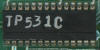
 This TI-88 is hiding one of the two TP0531 chips under the visible TP0532/CD5402 chip with the other TP0531 next to it.
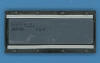
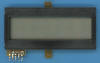 DISPLAY: The TI-88 makes use of a dot matrix LC-Display
with 16 characters supporting a 7x5 pixel font, each and a some extra status
symbols. The LC-Display itself with its 1034576-4 marking was obviously custom
manufactured in Japan for Texas Instruments. The Date code "1D4" of the
LC-Display Module from a TI-88 "PVT 3 Build" with Series Number 1073 translates
to 4th week in April 1981.
DISPLAY: The TI-88 makes use of a dot matrix LC-Display
with 16 characters supporting a 7x5 pixel font, each and a some extra status
symbols. The LC-Display itself with its 1034576-4 marking was obviously custom
manufactured in Japan for Texas Instruments. The Date code "1D4" of the
LC-Display Module from a TI-88 "PVT 3 Build" with Series Number 1073 translates
to 4th week in April 1981.
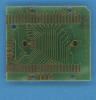
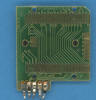
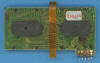 Texas Instruments developed with the
TP0530 a cascadable display driver
with 40 + 1 column drivers and 7 row drivers. Two of these drivers are used in
the TI-88, each driving one half of the LC-Display. The larger of the two PCBs
with the "M" marking generates the row-scanning of the LC-Display and connects
with 48 pads to it while the smaller PCB with the "S" marking sports just 42
pads.
Texas Instruments developed with the
TP0530 a cascadable display driver
with 40 + 1 column drivers and 7 row drivers. Two of these drivers are used in
the TI-88, each driving one half of the LC-Display. The larger of the two PCBs
with the "M" marking generates the row-scanning of the LC-Display and connects
with 48 pads to it while the smaller PCB with the "S" marking sports just 42
pads.
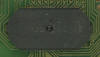
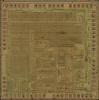 The Integrated Circuits with
a total of 63 connections are bonded directly in Chip-on-Board (COB) technology
on the printed circuit board and covered with a black epoxy blob.
The Integrated Circuits with
a total of 63 connections are bonded directly in Chip-on-Board (COB) technology
on the printed circuit board and covered with a black epoxy blob.
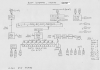 The
block diagram of the TP0530 provided by Jon Guidry reveals an interesting
structure with a pure serial approach, the CPU needs to clock-in 8 characters of
8 bits, each and 3 bits for the status information for each half of the display.
The characters are converted with an internal 7*5 font generator ROM into the 40
column signals while a free running counter address the 7 rows of the display
each. The 3-bit status information is simply reflected on one additional column
driver for a maximum of 7 different status signals for the user. The Master chip
is responsible for the scanning of the display and generates the timing for the
cascaded TP0530 chips.
The
block diagram of the TP0530 provided by Jon Guidry reveals an interesting
structure with a pure serial approach, the CPU needs to clock-in 8 characters of
8 bits, each and 3 bits for the status information for each half of the display.
The characters are converted with an internal 7*5 font generator ROM into the 40
column signals while a free running counter address the 7 rows of the display
each. The 3-bit status information is simply reflected on one additional column
driver for a maximum of 7 different status signals for the user. The Master chip
is responsible for the scanning of the display and generates the timing for the
cascaded TP0530 chips.
CRAM and CROM Modules
Two different type of modules were designed: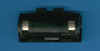 POWER SUPPLY: We
assume that all Integrated Circuits were manufactured in a low-power CMOS
process, nevertheless used Texas Instruments once again a rechargeable battery
pack labeled accordingly BP88.
POWER SUPPLY: We
assume that all Integrated Circuits were manufactured in a low-power CMOS
process, nevertheless used Texas Instruments once again a rechargeable battery
pack labeled accordingly BP88.
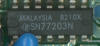
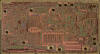 Instead of the 3 AA-sized NiCd cells of the TI-59 introduced in 1977, used
this design of 1981 just one AA-sized cell and a step-up converter
SN77203 to
generate both the supply voltage of the Integrated Circuits and LC-Display. The
battery is recharged with an AC9133 AC-Adapter, technically very similar to the
AC9132 used with the TI-30 and other
calculators but using a different connector.
Instead of the 3 AA-sized NiCd cells of the TI-59 introduced in 1977, used
this design of 1981 just one AA-sized cell and a step-up converter
SN77203 to
generate both the supply voltage of the Integrated Circuits and LC-Display. The
battery is recharged with an AC9133 AC-Adapter, technically very similar to the
AC9132 used with the TI-30 and other
calculators but using a different connector.
ALGORITHM: Running Mike Sebastian's "Calculator
forensics" gives a result of 9.000000955917. It took 7 years
before with the TI-68 another Texas
Instruments calculator achieved a similar precision.
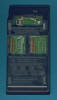 The TI-88 accommodates up to two modules in the rear
ports.
The TI-88 accommodates up to two modules in the rear
ports.
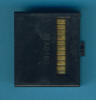
 • CRAM-Modules as user programmable memory with either 1184
program steps or 148 user memories.
• CRAM-Modules as user programmable memory with either 1184
program steps or 148 user memories.
With 0, 1 or 2 CRAM-Modules you get a total of:
| CRAM-Modules | Default | Max. Program steps | Max. User memory | |||
| Program steps | User memory | Program steps | User memory | Program steps | User memory | |
| 0 | 480 | 60 | 960 | 0 | 0 | 120 |
| 1 | 480 | 208 | 2144 | 0 | 0 | 268 |
| 2 | 480 | 356 | 3328 | 0 | 0 | 416 |
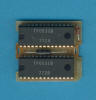
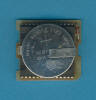
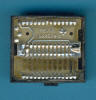 Dismantling a CRAM-Module from the final TI-88 PVT
4 Build reveals two TP0531
Read/Write Memories with 4,800 Bits or 600 Bytes capacity, each and a Sanyo 3 Volts lithium battery
with 24.5 mm diameter and a thickness of 3.5 mm - matching today's
CR2430 cells.
Dismantling a CRAM-Module from the final TI-88 PVT
4 Build reveals two TP0531
Read/Write Memories with 4,800 Bits or 600 Bytes capacity, each and a Sanyo 3 Volts lithium battery
with 24.5 mm diameter and a thickness of 3.5 mm - matching today's
CR2430 cells.
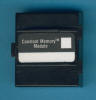
 •
CROM-Modules as pre-programmed software like the earlier
TI-58C/TI-59 Solid State Software™ modules with up to 15,000 program steps.
•
CROM-Modules as pre-programmed software like the earlier
TI-58C/TI-59 Solid State Software™ modules with up to 15,000 program steps.
Eight
modules were already defined in the sales brochures:

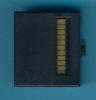
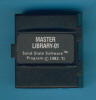
 Dismantling a
Master Library CROM-Module from the final TI-88 PVT 4 Build reveals one
TP0532
Read Only Memory with Custom Software CD5403 with 120,000 Bits capacity organized as 15,000 Bytes.
Dismantling a
Master Library CROM-Module from the final TI-88 PVT 4 Build reveals one
TP0532
Read Only Memory with Custom Software CD5403 with 120,000 Bits capacity organized as 15,000 Bytes.
Lucky
Numbers?
People in China traditionally associate luck with numbers. As a rule in day-to-day life in China, it is customary to regard even numbers as being more auspicious than odd numbers. Eight, 'Ba' in Chinese has a similar sound to 'Fa', which means to make a fortune. All business men favor this number very much. However, for Texas Instruments the "8" in the type designation was not always a fortune.
We remember some very unlucky calculators:
| Calculator | Introduction | |
| TI-18 | 1982 | A BASIC calculator with a SCIENTIFIC appeal |
| TI-38 | 1979 | The odd sibling of the TI-50 and TI-53 |
| TI-68 | 1989 | How NOT to do a keyboard layout |
| TI-78 | 1990 | Too late? Too advanced? Who knows... |
| TI-88 | (1982) | Killed by competition? |
| TI-98 | (2002) | Just a fantasy number, but it would fit. |
History repeats - don't miss the story about the PET Project!

If you have additions to the above article please email: joerg@datamath.org.
© Joerg Woerner, May 11, 2007. No reprints without written permission.