DATAMATH CALCULATOR MUSEUM
|
DATAMATH CALCULATOR MUSEUM |
Caltronic Model 812
| Date of introduction: | September 1972 | Display technology: | LED modules |
| New price: | Display size: | 8 + Sign | |
| Size: | 5.8" x 3.0" x 1.25" 148 x 77 x 32 mm3 |
||
| Weight: | 6.7 ounces, 191 grams | Serial No: | 50086 |
| Batteries: | 9V Alkaline | Date of manufacture: | mth 12 year 1972 |
| AC-Adapter: | Origin of manufacture: | Hong Kong | |
| Precision: | 8 (12) | Integrated circuits: | CT5002, 2*SN75492, CA3081 |
| Logic: | Adding Machine | Displays: | 3*Litronix DL-33 |
| Memories: | |||
| Program steps: | Courtesy of: | Joerg Woerner | |
| Download manual: |  (DE: 5.6M Bytes)
 |
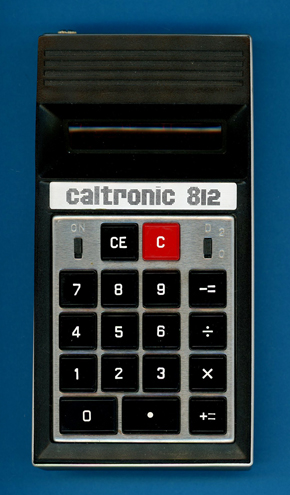
 Harber Industries Limited in Hong Kong entered the calculator business in 1972 with the Caltronic 812 and soon offered its product line as white-label products to OEMs (Original Equipment Manufacturer) like
Quelle and
Neckermann in Germany and UK-based Plustronics Ltd. Although total sales approached one million calculators in 1973, the business was not sustainable for the contract manufacturer, Coltronics, a subsidiary of Cable
& Wireless Ltd. in Hong Kong, which discontinued calculator production in 1974.
Harber Industries Limited in Hong Kong entered the calculator business in 1972 with the Caltronic 812 and soon offered its product line as white-label products to OEMs (Original Equipment Manufacturer) like
Quelle and
Neckermann in Germany and UK-based Plustronics Ltd. Although total sales approached one million calculators in 1973, the business was not sustainable for the contract manufacturer, Coltronics, a subsidiary of Cable
& Wireless Ltd. in Hong Kong, which discontinued calculator production in 1974.
As implied by its model number, 812, the Caltronic 812 is built around a calculator chip with 12-digit internal precision but an 8-digit LED display. The discrepancy between internal precision and visible output results in several surprising operating characteristics (Examples shown with Decimal Point switch set to [0 2]:
|
• Entering the 9th digit is resulting in the two left most
decimal points lit up: [1] [2] [3] [4] [5] [6] [7] [8] [9] → 2.3.456789 • Entering the 13th digit is resulting in an overflow with all zeroes and seven decimal points: → 0.0.0 0.0.0.0.0. • Calculations with 9 to 12 digits are shown with the three decimal points lit up: [1] [2] [3] [4] [5] [x] [1] [2] [3] [4] [5] [+=] → 5.2.399025. and allowing further calculations: [:] [1] [0] [0] [+=] → 1523990. • Calculations with more than 12 digits are resulting in an overflow with all zeroes and seven decimal points: [1] [2] [3] [4] [5] [x] [1] [2] [3] [4] [5] [x] [1] [2] [3] [4] [5] [+=] → 0.0.0 0.0.0.0.0. |
Introduced in September 1972, at the dawn of the Calculator War, the Caltronic 812 came under intense cost-reduction pressure. As a result, Coltronics implemented numerous design and manufacturing changes throughout the calculator's production life:
|
• Substitution of two segment driver chips with resistors • Elimination of the connector between the Main-PCB and the keyboard/display assembly • Redesign of the internal construction of the calculator, resulting in a smaller housing • Switching the PCB substrate from fiberglass-reinforced epoxy laminate to phenolic laminate • Replacing the Cal-Tex calculator chip with a product from Mostek |
In addition, Caltronic introduced with the Models 606 and 612 two variations using 6-digit display and replacing the Texas Instruments Klixon keyboards to further reduce manufacturing costs.
We acquired this Caltronic 812 calculator together with three other calculators on our quest to untangle the relationships between the MK6010L, MK5012, MK5010, and Cal-Tex CT5002 single-chip calculator circuits. Each calculator went through our "Teardown Treatment", Characterization of Single-Chip Calculator Circuits and De-capping and Chip-Photography:
|
• MK6010L - Busicom
LE-120S,
Teardown,
Characterization,
Die Photo • MK5012 - Caltronic 912, Teardown, Characterization, Die Photo • MK5010 - Rapid Data Rapidman 800, Teardown, Characterization, Die Photo • CT5002 - Caltronic 812, Teardown, Characterization, Die Photo |
In addition did we acquire multiple Caltronic calculators and their OEM products manufactured for Neckermann and Quelle (Privileg brand) to understand the various cost-reduction measures and hoping to discover the rumored Cal-Tex CT5012 chip:
| Model | Production Date |
Serial # | Main-PCB Marking |
Calculator Chip |
Display Size |
Display Type |
Display Connector |
Segment Driver |
Keyboard Assembly |
Housing Thickness |
| Caltronic 812 | Dec. 1972 | 50046 | CT52 | CT5002 | 9-digits | 3*DL33 | Yes | No | TI Klixon | 1.25" - 32 mm |
| Caltronic 912 | Feb. 1973 | 172388 | CT52 | MK5012 | 9-digits | 3*DL33 | No | BJT | TI Klixon | 0.90" - 23 mm |
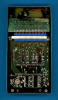

 Dismantling
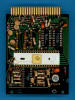
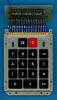
the featured Caltronic 812 calculator manufactured in December 1972 in Hong Kong reveals an
interesting internal construction using one connector between its Main-PCB, the
Display-PCB and the Keyboard Assembly:
Dismantling
the featured Caltronic 812 calculator manufactured in December 1972 in Hong Kong reveals an
interesting internal construction using one connector between its Main-PCB, the
Display-PCB and the Keyboard Assembly:
|
• Main-PCB - Cal-Tex CT5002 single-chip calculator circuit, display driver,
keyboard encoding and power supply • Display-PCB - Three Litronix 3-digit 7-segment LED display modules and one indicator LED • Keyboard Assembly - Texas Instruments Klixon™ keyboard array |
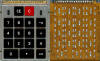
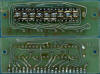
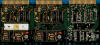 To
gain some knowledge about the differences between the
CT5002 located in this Caltronic 812
and the MK5012 used with the Caltronic
912, we
decided here at the Datamath Calculator Museum to give it a "Teardown
Treatment" and sharing our findings accordingly.
To
gain some knowledge about the differences between the
CT5002 located in this Caltronic 812
and the MK5012 used with the Caltronic
912, we
decided here at the Datamath Calculator Museum to give it a "Teardown
Treatment" and sharing our findings accordingly.
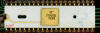 Calculating Unit: When Mostek introduced in November 1970 with the
MK6010 the World’s first "single-chip calculator circuit", it was sold exclusively to Nippon Calculating Machine Corp of Japan for their Busicom Model 120-DM small desktop calculator, also known as Busicom
Junior, and not available to other customers. Recognizing the resulting gap in the market, Cal-Tex immediately began developing a fully functional, pin-compatible replacement. Formally introduced in November 1971 - exactly one year after the original MK6010 - and with first silicon available in January 1972, the
CT5001 quickly found its first major design win in the highly successful Unitrex
1200 (Type 27) desktop calculator.
Calculating Unit: When Mostek introduced in November 1970 with the
MK6010 the World’s first "single-chip calculator circuit", it was sold exclusively to Nippon Calculating Machine Corp of Japan for their Busicom Model 120-DM small desktop calculator, also known as Busicom
Junior, and not available to other customers. Recognizing the resulting gap in the market, Cal-Tex immediately began developing a fully functional, pin-compatible replacement. Formally introduced in November 1971 - exactly one year after the original MK6010 - and with first silicon available in January 1972, the
CT5001 quickly found its first major design win in the highly successful Unitrex
1200 (Type 27) desktop calculator.
Busicom recognized the potential of Mostek's ion-implantation process, which led to the introduction of the low-voltage, low-power MK6010L in February 1971. The first application of the MK6010L was a remarkably compact, battery-operated handheld calculator with LED displays - quite the opposite of the original MK6010, which had been designed for a large, AC-powered desktop calculator with a VFD. Although Busicom succeeded in squeezing the required DC/DC converter and LED drivers into an exceptionally compact housing, the manufacturing costs of the LE-120A and its successor, the LE-120S, remained prohibitively high.
Early in 1972, Cal-Tex carefully analyzed the requirements for an alternative to the MK6010L. The result was the CT5002, introduced in August 1972 as a single-supply version of the CT5001 optimized for portable, battery-powered calculators with LED displays.
The CT5002 offered several advantages over the MK6010L, enabling more cost-effective calculator designs:
|
• Single-supply voltage of VDD =
−6 V • Integrated 2-phase clock generation from 1-phase clock input • Positive logic of Digit and Segment outputs for easy interfacing to LED Displays • Display inhibit feature for power conservation |
 Display:
The featured Caltronic 812 calculator, manufactured in Dexember 1972, utilizes a
9-digit LED display assembly composed of three Litronix DL-33 3-digit seven-segment LED displays housed in
12-pin packages and soldered onto
the double-sided Display-PCB. In addition to the numeric displays, the Display-PCB incorporates
an indicator LEDs for low-battery status. The
Display-PCB is connected to the Main-PCB and Keyboard Assembly of the Caltronic
812 with 22 hand-soldered connections directly to one side of a two-row
connector.
Display:
The featured Caltronic 812 calculator, manufactured in Dexember 1972, utilizes a
9-digit LED display assembly composed of three Litronix DL-33 3-digit seven-segment LED displays housed in
12-pin packages and soldered onto
the double-sided Display-PCB. In addition to the numeric displays, the Display-PCB incorporates
an indicator LEDs for low-battery status. The
Display-PCB is connected to the Main-PCB and Keyboard Assembly of the Caltronic
812 with 22 hand-soldered connections directly to one side of a two-row
connector.
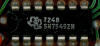 Display Driver:
The CT5002 single-chip calculator circuit was designed to directly interface
with off-the-shelf display drivers like Texas Instruments'
SN75491 (4 segment drivers) and
SN75492 (6 digit Drivers). Accordingly, the
Main-PCB of the Caltronic 812 was laid out to accommodate four of these devices
- two for driving the display segments (anodes) and two for the digit lines (cathodes). However, in the production design, the dedicated segment driver ICs was eliminated and replaced by eight discrete current-limiting resistors. Thanks to the high luminous efficiency of the Litronix DL33 LED display modules, the CT5002 was capable of driving the segment anodes directly, making the additional driver IC unnecessary.
Display Driver:
The CT5002 single-chip calculator circuit was designed to directly interface
with off-the-shelf display drivers like Texas Instruments'
SN75491 (4 segment drivers) and
SN75492 (6 digit Drivers). Accordingly, the
Main-PCB of the Caltronic 812 was laid out to accommodate four of these devices
- two for driving the display segments (anodes) and two for the digit lines (cathodes). However, in the production design, the dedicated segment driver ICs was eliminated and replaced by eight discrete current-limiting resistors. Thanks to the high luminous efficiency of the Litronix DL33 LED display modules, the CT5002 was capable of driving the segment anodes directly, making the additional driver IC unnecessary.
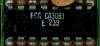 Clock: The
CT5002 single-chip calculator circuit used in the Caltronic 812 operates from an
internal generated two-phase clock running at approximately 20 kHz based on an
external clock signal with twice the frequency. The clock signal is generated by an astable multivibrator consisting of
three BJTs integrated an RCA CA3081 transistor array, which is located on the calculator's
Main-PCB.
Clock: The
CT5002 single-chip calculator circuit used in the Caltronic 812 operates from an
internal generated two-phase clock running at approximately 20 kHz based on an
external clock signal with twice the frequency. The clock signal is generated by an astable multivibrator consisting of
three BJTs integrated an RCA CA3081 transistor array, which is located on the calculator's
Main-PCB.
Power Supply: The Caltronic 812 calculator is powered by a
disposable 9 V alkaline battery. A simple linear voltage regulator generates
an additional supply voltage required by the CT5002 calculator chip:
|
• VSS - Positive supply for
CT5002 (9.0 V) from battery • VDD - Negative supply for CT5002 (3.0 V) from linear regulator • GND - Negative supply for LED Display (0 V) from battery |
We measured the operating current of the featured Caltronic 812 calculator for four different cases:
| Mode | Display | Current VBAT = 9.0 V |
Clock Frequency |
| Calculating | 0. | 13 mA | 48 kHz |
| Calculating | - 0. | 16 mA | 48 kHz |
| Calculating | 88888888 | 28 mA | 48 kHz |
| Display Hold | H. | 12 mA | 48 kHz |
Calculating the power consumption at 9 Volts for the Caltronic 812 results in about 120 mW displaying a '0.' and about 250 mW with all segments illuminated, excellent numbers for an LED-based calculator designed in 1972. A Caltronic 912, based on Mostek's MK5012, clocked in at 350 mW and 500 mW, respectively - clearly demonstrating the optimization of the CT5002 for LED-based, battery-operated calculators.
Keyboard: The Caltronic 812 uses a
Klixon™ 1KS116
keyboard assembly consisting of the "Basic 1KS" keyboard array with 17
snap-action Klixon discs mounted on a printed circuit board for the interconnections of the
switches to
the external calculator circuit and a stainless steel mounting frame and the
molded keytops. In addition, the keyboard assembly integrates two two-position slide switches: one for selecting the decimal-point position and the other for switching the calculator power on and off.
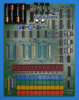 Here
at the Datamath Calculator Museum we use
the DCM-50A Platform to
Characterize and
Reverse-engineer
Single-chip Calculator Circuits. Many designs of electronic calculators do not
use all features of their calculator brains and it would be difficult to unleash
the full potential of the calculator chips in these cases. Additionally are
electronic calculators "closed systems" with limited flexibility to measure
signals, change voltages or clock frequencies, provide additional input keys or
even change the display technology or specifications additional digits. Core
idea of the DCM-50A is providing a generic platform to access all features of a
single-chip calculator circuit and with the
DCM-50A (PLAYGROUND) we
increased the scope from Texas Instruments products to offerings from their
competitors in the 1970s, namely AMI, Cal-Tex, Commodore/MOS Technology,
Electronic Arrays, General Instrument, Hitachi, Litronix, Matsushita,
Mitsubishi, Mostek, National Semiconductor, NEC, Omron, RFT, Rockwell, Sharp,
Toshiba, and Western Digital.
Here
at the Datamath Calculator Museum we use
the DCM-50A Platform to
Characterize and
Reverse-engineer
Single-chip Calculator Circuits. Many designs of electronic calculators do not
use all features of their calculator brains and it would be difficult to unleash
the full potential of the calculator chips in these cases. Additionally are
electronic calculators "closed systems" with limited flexibility to measure
signals, change voltages or clock frequencies, provide additional input keys or
even change the display technology or specifications additional digits. Core
idea of the DCM-50A is providing a generic platform to access all features of a
single-chip calculator circuit and with the
DCM-50A (PLAYGROUND) we
increased the scope from Texas Instruments products to offerings from their
competitors in the 1970s, namely AMI, Cal-Tex, Commodore/MOS Technology,
Electronic Arrays, General Instrument, Hitachi, Litronix, Matsushita,
Mitsubishi, Mostek, National Semiconductor, NEC, Omron, RFT, Rockwell, Sharp,
Toshiba, and Western Digital.
On our quest to document Mostek's MK6010 Chip and its
many descendants like the MK5010, MK5011, MK5012 and Cal-Tex' CT5001, CT5002, and
CT5012, we developed here at the Datamath Calculator Museum three additional
tools for our DCM-50A (PLAYGROUND):
| •
DCM-50A
(PLAYGROUND) MK6010 Adapter: Daughter Board for the
DCM-50A (PLAYGROUND)
Digit Inverter Frame Carrier for
Mostek's MK6010 Product Family • DCM-50A (PLAYGROUND) KBD102 Keyboard: Keyboard with 20 individual keys to support the MK6010-style BCD-Encoding keyboard input • DCM-50A (PLAYGROUND) Digilent I/O Extender: Plug-In Board to add six additional Input Signals for the Digilent Discovery |
Comparing the Calculator Logic Implementation of the CT5002 retrieved from the featured Caltronic 812 calculator with the Calculator Logic Implementation of the CT5001 chip used with the Unisonic 1200 (Type 27) and the Calculator Logic Implementation of the MK5012 chip used with the Caltronic 912 reveals only subtle differences: An Entry or Calculating Overflow is signaled with the CT5001 and MK5012 showing '0.0.0.0.0.0.0.0.0.0.0.0', while the CT5002 is showing '00000000.0.0.0.0.'. Pressing the [C] or [CE] key lit up the display with all 12 digits showing '000000000000' with the both the CT5001 and the CT5002, while the MK5012 is showing '888888888888'. More importantly, all discovered Calculator Logic Bugs of the CT5001 are still present with the CT5002.
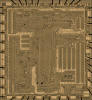 In
a next step, we decided to "decap" the
CT5001, CT5002 and MK5012 chips salvaged from the Unitrex 1200 (Type 27), Caltonic
812 and Caltronic 912
calculators and asked Sean Riddle to
provide us with high-resolution images of the silicon dies.
In
a next step, we decided to "decap" the
CT5001, CT5002 and MK5012 chips salvaged from the Unitrex 1200 (Type 27), Caltonic
812 and Caltronic 912
calculators and asked Sean Riddle to
provide us with high-resolution images of the silicon dies.
First surprise: The silicon die inside the CT5002 package is
marked with 06/23/72 indicating its design date.
 Second
surprise: The CT5002 chip looks almost identical to the CT5001 chip.
Second
surprise: The CT5002 chip looks almost identical to the CT5001 chip.

If you have additions to the above article please email: joerg@datamath.org.
© Joerg Woerner, June 27, 2026. No reprints without written permission.