DATAMATH CALCULATOR MUSEUM
|
DATAMATH CALCULATOR MUSEUM |
Texas Instruments SR-52
| Date of introduction: | September 16, 1975 | Display technology: | LED-stick |
| New price: | $ 395.00 (SRP 1975), DM 1199.00 | Display size: | 10 + 2 |
| Size: | 6.5" x 3.3" x
1.7" 164 x 84 x 44 mm3 |
||
| Weight: | 10.0 ounces, 284 grams | Serial No: | 20180 |
| Batteries: | BP1A | Date of manufacture: | wk 51 year 1975 |
| AC-Adapter: | AC9130A or DC9105 | Origin of manufacture: | USA (DTA) |
| Precision: | 12/13 | Integrated circuits: | TMC0501, TMC0524, TMC0562, TMC0563, TMC0595, 2*TMC0599, SN97211 |
| Logic: | AOS - 10 Pending Operations, 9 () | Displays: | DIS234G |
| Memories: | 20 | ||
| Program steps: | 224 | Courtesy of: | Joerg Woerner |
| Download leaflets: |  (US: 4.5M Bytes)
(US: 3.5M Bytes)
(US: 7.8M Bytes)
(US: 4.5M Bytes)
(US: 3.5M Bytes)
(US: 7.8M Bytes) |
Download manuals: |
(US: 26.8M Bytes)
(US: 2.8M Bytes) |
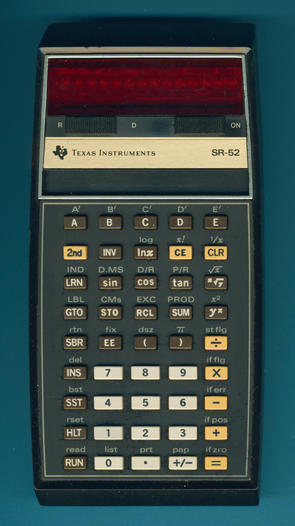

 If
you call the SR-52 a pocket calculator you need really huge pockets. Introduced
in Fall 1975, this wonderful calculator integrated a card reader for magnetic
strips, a huge memory for 224 program steps and the revolutionary
Algebraic Operating
System (AOS™) into a
housing similar to the SR-50A calculator. By the way,
the SR-52 was the thickest calculator ever with a whooping 1.8". Together
with the calculator a "Printed Cradle" PC-100
was introduced, a thermal printer and plotter which secured the SR-52. In
September 1975 a the SR-52 was with a Suggested Retail Price of US$ 395 (around
US$ 2,200 inflation adjusted in 2023 money) not really a bargain. The SR-52 was clearly placed
against the Hewlett-Packard HP-65,
later the HP-67 featured an
identical memory space to the SR-52.
If
you call the SR-52 a pocket calculator you need really huge pockets. Introduced
in Fall 1975, this wonderful calculator integrated a card reader for magnetic
strips, a huge memory for 224 program steps and the revolutionary
Algebraic Operating
System (AOS™) into a
housing similar to the SR-50A calculator. By the way,
the SR-52 was the thickest calculator ever with a whooping 1.8". Together
with the calculator a "Printed Cradle" PC-100
was introduced, a thermal printer and plotter which secured the SR-52. In
September 1975 a the SR-52 was with a Suggested Retail Price of US$ 395 (around
US$ 2,200 inflation adjusted in 2023 money) not really a bargain. The SR-52 was clearly placed
against the Hewlett-Packard HP-65,
later the HP-67 featured an
identical memory space to the SR-52.
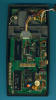 The
SR-52 was an important milestone in the history of programmable calculators
based on the
TMS0500 Building Blocks for Scientific and Programmable Calculators introduced
in January 1974 with the SR-50 and leading to the
legendary TI-59.
The
SR-52 was an important milestone in the history of programmable calculators
based on the
TMS0500 Building Blocks for Scientific and Programmable Calculators introduced
in January 1974 with the SR-50 and leading to the
legendary TI-59.
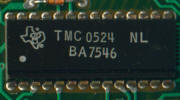
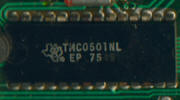 The remarkable SR-52 uses most features of the
TMC0500 Architecture. A deeper exploration of the calculator reveals a
TMC0501 Revision E or
TMC0501E Arithmetic Chip surrounded by one
TMC0524 SCOM (Scanning and Read Only
Memory) Chip, two TMC0561/TMC0562 BROM (Bare
Read Only Memory) Chips for a combined 3k*13 Bits instruction memory.
The remarkable SR-52 uses most features of the
TMC0500 Architecture. A deeper exploration of the calculator reveals a
TMC0501 Revision E or
TMC0501E Arithmetic Chip surrounded by one
TMC0524 SCOM (Scanning and Read Only
Memory) Chip, two TMC0561/TMC0562 BROM (Bare
Read Only Memory) Chips for a combined 3k*13 Bits instruction memory.
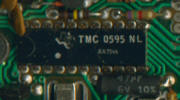
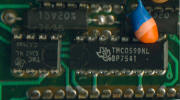 In
addition you'll notice on the printed circuit board (PCB) two TMC0599
Multi-Register Chips for program and data and finally a
TMC0595 Magnetic I/O Chip controlling the internal
magnet card read/writer.
In
addition you'll notice on the printed circuit board (PCB) two TMC0599
Multi-Register Chips for program and data and finally a
TMC0595 Magnetic I/O Chip controlling the internal
magnet card read/writer.
A calculator with a similar
feature set was sold with the huge desktop-model
SR-60.
The related SR-56 lacks the magnetic card reader and
sports a smaller user memory.
In November 1976 Texas Instruments announced PPX-52 (Professional Program Exchange), a service for SR-52 users in the U.S., Canada and Mexico to gather, compile and redistribute programs for the calculator. It was in Fall 1977, shortly after the introduction of the TI-59, merged with the PPX-59. All PPX-52 Newsletters are available for free download as a service provided by the Datamath Calculator Museum.
Don't miss the secrets of the SR-52 and read about some Undocumented Features.
At first glance the calculating precision of the SR-52 was reduced from 13 digits to 12 digits compared with earlier scientific calculators based on the TMC0501 Arithmetic chip, for instance the SR-51. But fellow collector Palmer Hanson revealed in October 2009, almost 35 years after its introduction, the remaining secrets of the SR-52. Don't miss the Story "Twelve or Thirteen Digits on the SR-52."
If you are interested in the calculating accuracy of scientific calculators, don't miss the Calculator forensics.
 Comparing
the Constant ROM Content with
the programmed constants frequently used with computing algorithm of
trigonometric functions like sine, cosine, or tangent of an SR-50 manufactured in
May 1974 still using the original TMC0521-2 SCOM Chip with the TMC0524B Chip
of the featured SR-52 with our
TMS0500 Platform after recording their
ROM Images showed no
differences.
Comparing
the Constant ROM Content with
the programmed constants frequently used with computing algorithm of
trigonometric functions like sine, cosine, or tangent of an SR-50 manufactured in
May 1974 still using the original TMC0521-2 SCOM Chip with the TMC0524B Chip
of the featured SR-52 with our
TMS0500 Platform after recording their
ROM Images showed no
differences.
If you are interested in "huge pocket calculators"
you should view the Canon Palmtronic F-7
and Casio PRO fx-1.
Fellow collectors - if you own a SR-52 please report us the serial number and date code on the back of the calculator for our SR-52 Database.
| Serial Number | Origin | Date code | Logo | Owner |
| 11115 | USA |
DTA 4675 |
Francois Lanciault | |
| 11215 | USA |
DTA 4475 |
Juri Schauder | |
| 11270 | USA |
DTA 4475 |
Hugh Fraser | |
| 11486 | USA |
DTA 4675 |
Robert Phillips | |
| 11583 | USA |
DTA 5275 |
Dave Ramey | |
| 11930 | USA |
DTA 5275 |
Mark Crouse | |
| 12361 | USA |
DTA 0276 |
Miroslav Krob | |
| 13186 | USA |
DTA 4775 |
Kirk B. Muri | |
| 13416 | USA |
DTA 4575 |
Mikel J. Harris | |
| 13948 | USA |
DTA 4775 |
Joerg Woerner | |
| 13952 | USA |
DTA 4775 |
Wayne Bouchard | |
| 14131 | USA |
DTA 4775 |
Alberto Fenini | |
| 14328 | USA |
DTA 4875 |
Willy Kunz | |
| 14440 | USA |
DTA 4875 |
Didier Lachieze | |
| 15621 | USA |
DTA 0476 |
Marc Yaseen | |
| 16307 | USA |
DTA 0476 |
André Wilhelmus | |
| 16511 | USA |
DTA 0476 |
Victor Rollinger | |
| 16587 | USA |
DTA 0476 |
Katie Poole | |
| 17125 | USA |
DTA 0676 |
Wesley Griffith | |
| 17538 | USA |
DTA 0776 |
Claus Buchholz | |
| 18314 | USA |
DTA 0776 |
Bill Brown | |
| 18679 | USA |
DTA 0776 |
Bo Sörensson | |
| 20180 | USA |
DTA 5175 |
Joerg Woerner | |
| 23416 | USA |
DTA 0876 |
Jeffrey Jonas | |
| 23643 | USA |
DTA 0876 |
Francis Teyssier | |
| 24777 | USA |
DTA 0876 |
Wolfgang Kemper | |
| 25031 | USA |
DTA 0876 |
Erik Theunissen | |
| 32253 | USA |
DTA 1176 |
Alberto Fenini | |
| 32860 | USA |
DTA 1176 |
Alberto Fenini | |
| 33359 | USA |
DTA 1276 |
Joerg Woerner | |
| 33663 | USA |
DTA 1376 |
Mac Derscheid | |
| 33998 | USA |
DTA 1376 |
François Lanciault | |
| 34505 | USA |
DTA 1376 |
Daniel Rios | |
| 35405 | USA |
DTA 1376 |
Kirk B. Muri | |
| 35678 | USA |
DTA 1376 |
Thierry Bru | |
| 35849 | USA |
DTA 1376 |
Ralph Pandel | |
| 36325 | USA |
DTA 1376 |
Joerg Woerner | |
| 36603 | USA |
DTA 1476 |
Klaus Sieber | |
| 36844 | USA |
DTA 1376 |
Joerg Woerner | |
| 37331 | USA |
DTA 1576 |
Bernd Ulmann | |
| 37692 | USA |
DTA 1376 |
Joerg Woerner | |
| 38362 | USA |
DTA 1376 |
Kirk B. Muri | |
| 38938 | USA |
DTA 1376 |
J. Steve Dodds | |
| 38945 | USA |
DTA 1376 |
Greg Lane | |
| 40046 | USA |
DTA 1076 |
Gene McNair | |
| 42047 | USA |
DTA 0876 |
Terry Bertrand | |
| 43520 | USA |
DTA 1076 |
Marie Lisa Collas | |
| 43176 | USA |
DTA 0876 |
Brian DeLuca | |
| 43939 | USA |
DTA 1076 |
Peter Bach | |
| 48299 | USA |
DTA 0976 |
Ricardo Rodríguez | |
| 48955 | USA |
DTA 1076 |
Huub van Luijt | |
| 47413 | USA |
DTA 0876 |
Julian Burke | |
| 49362 | USA |
DTA 1076 |
Joerg Woerner | |
| 50061 | USA |
DTA 0876 |
Peter Carlsen | |
| 50591 | USA |
DTA 0876 |
Wolfgang Mueller | |
| 50683 | USA |
DTA 0876 |
François Gueissaz | |
| 50913 | USA |
DTA 0876 |
Angelo Elifani | |
| 51248 | USA |
DTA 0876 |
Zbynek Hak | |
| 51130 | USA |
DTA 0876 |
Alain Chancé | |
| 51796 | USA |
LTA 2076 |
Clemens Driessen | |
| 53151 | USA |
LTA 1776 |
Joerg Woerner | |
| 53750 | USA |
LTA 1776 |
Helmut Albrecht | |
| 58729 | USA |
LTA 1776 |
Martin Desax | |
| 58890 | USA |
LTA 1776 |
Greg Lane | |
| 021832 | USA |
LTA 3576 |
Kirk B. Muri | |
| 022300 | USA |
LTA 3576 |
Thierry Bru | |
| 026605 | USA |
LTA 4376 |
Ronald Richardson | |
| 030069 | USA |
LTA 2476 |
Eric Moorhouse | |
| 041139 | USA |
LTA 0377 |
Alberto Fenini | |
| 041189 | USA |
LTA 0377 |
Joerg Woerner | |
| 046268 | USA |
LTA ___ |
Tom Gervascio | |
| 051553 | USA |
LTA 2076 |
Karol Groh | |
| 052418 | USA |
LTA 1776 |
Alberto Fenini | |
| 053040 | USA |
LTA 1776 |
Alberto Fenini | |
| 057299 | USA |
LTA 2576 |
Tony Buckley | |
| 058528 | USA |
LTA 1776 |
Alberto Fenini | |
| 060028 | USA |
LTA 2076 |
Pavel Nemec | |
| 060224 | USA |
LTA 2076 |
Frank Nijkamp | |
| 060985 | USA |
LTA 2076 |
Phylip Hoarau | |
| 061844 | USA |
LTA 3076 |
Phylip Hoarau | |
| 061959 | USA |
LTA 3076 |
Michael Guettler | |
| 062175 | USA |
LTA 3076 |
Tom Johnson | |
| 062995 | USA |
LTA 3276 |
Wayne Bouchard | |
| 063252 | USA |
LTA 3276 |
Wesley Griffith | |
| 064546 | USA |
LTA 3476 |
Josef Ladra | |
| 065498 | USA |
LTA 3776 |
Harry Brugmans | |
| 068734 | USA |
LTA 2976 |
Katie Poole | |
| 068862 | USA |
LTA 2976 |
Peter Carlsen | |
| 070720 | USA |
LTA 3976 |
Jason Crump | |
| 071226 | USA |
LTA 3976 |
Kirk B. Muri | |
| 075155 | USA |
LTA 3776 |
Alberto Fenini | |
| 076747 | USA |
LTA 3876 |
Kirk B. Muri | |
| 084280 | USA |
LTA 4776 |
Thomas Rode | |
| 084673 | USA |
LTA 4776 |
Wesley Griffith | |
| 084920 | USA |
LTA 4776 |
Kirk B. Muri | |
| 086542 | USA |
LTA 5176 |
Thomas Gardiner | |
| 087639 | USA |
LTA 4576 |
Marc Paquette | |
| 088976 | USA |
LTA 4676 |
William Eburn | |
| 089043 | USA |
LTA 4676 |
Glenn Chappell | |
| 936029 | USA |
LTA 4476 |
Gianni Civita | |
| 938730 | USA |
LTA 4276 |
Marco Antonio Silveira de Souza | |
| 941409 | USA |
LTA 4276 |
Pablo Walls | |
| 942043 | USA |
LTA 4176 |
Ed Gersten | |
| 942058 | USA |
LTA 4276 |
Alberto Fenini | |
| 952114 | USA |
LTA 0577 |
Ron Silva | |
| 953114 | USA |
LTA 4176 |
Alberto Fenini | |
| 953968 | USA |
LTA 4176 |
Kirk B. Muri | |
| 954104 | USA |
LTA 4176 |
Kevin N. Schwinkendorf | |
| 955025 | USA | LTA 0877 | Kirk B. Muri | |
| 955072 | USA | LTA 0877 | Thierry Bru | |
| 955283 | USA | LTA 0677 | Chris Tang | |
| 956626 | USA | LTA 0877 | Alexey A Nikitin | |
| 956636 | USA | LTA 0977 | Carl Crown | |
| 956679 | USA | LTA 0977 | Kirk B. Muri | |
| 959591 | USA | LTA 0677 | Joerg Woerner | |
| 961340 | USA | LTA 0877 | Marie Lisa Collas | |
| 963481 | USA | LTA 0977 | Kipp Cannon | |
| 6829819 | USA | LTA 1477 | Gary D. Snyder | |
| 6831404 | USA | LTA 1777 | Blake McBride | |
| 6831992 | USA | LTA 1777 | David Fair | |
| 6832449 | USA | LTA 1777 | Thierry Bru | |
| 6832457 | USA | LTA 1777 | Ron Webb | |
| 9100952 | Netherlands | 2376 ACH | Inger-Lise Ekkelund Andersen | |
| 9101045 | Netherlands | 2276 ACH | Guy Drew | |
| 9101078 | Netherlands | 2276 ACH | Warry Spykstra | |
| 9102384 | Netherlands | 3076 ACH | R. Wuest | |
| 9102385 | Netherlands | 3076 ACH | Bernd Leutner | |
| 9103345 | Netherlands | 3176 ACH | Ken Turnbull | |
| 9105555 | Netherlands | 3976 ACH | Roswitha Piesch | |
| 9105611 | Netherlands | 3976 ACH | O.G.Petersen | |
| 9105875 | Netherlands | 3976 ACH | Pierre Houbert | |
| 9105950 | Netherlands | 3976 ACH | Glenn Whitney | |
| 9108399 | Netherlands | 2376 ACH | Angelo Elifani | |
| 9113384 | Netherlands | 0577 ACH | Andre Labbe | |
| 9114604 | Netherlands | 4776 ACH | Bernd Ulmann | |
| 9115819 | Netherlands | 5176 ACH | Rik Bos | |
| 9116929 | Netherlands | 4076 ACH | Miroslav Krob | |
| 9117294 | Netherlands | 4176 ACH | Acibase Alessandro | |
| 9117356 | Netherlands | 4176 ACH | Arnold Kaarsbaan | |
| 9117427 | Netherlands | 4176 ACH | PJ Ballard | |
| 9118313 | Netherlands | 4476 ACH | Forró Béla Romania | |
| 9118881 | Netherlands | 4476 ACH | Lars Wickenberg | |
| 9119066 | Netherlands | 4476 ACH | Zbynek Hak | |
| 9119560 | Netherlands | 4576 ACH | Didier Lachieze | |
| 9120784 | Netherlands | 2177 ACH | Marie Lisa Collas | |
| 9123649 | Netherlands | 1777 ACH | Matthias Krambeck | |
| 9124016 | Netherlands | 1477 ACH | Andre Labbe | |
| 9124590 | Netherlands | 1477 ACH | Andre Labbe | |
| 9124590 | Netherlands | 1477 ACH | Martin Gubler | |
| 9124732 | Netherlands | 1677 ACH | Leonardo Galeone | |
| 912481? | Netherlands | 1577 ACH | Andreas Eidenberger | |
| 912520_ | Netherlands | 1277 ACH | Chris Straub | |
AOS™ is a trademark of Texas Instruments.

If you have additions to the above article please email: joerg@datamath.org.
© Joerg Woerner, December 5, 2001. No reprints without written permission.